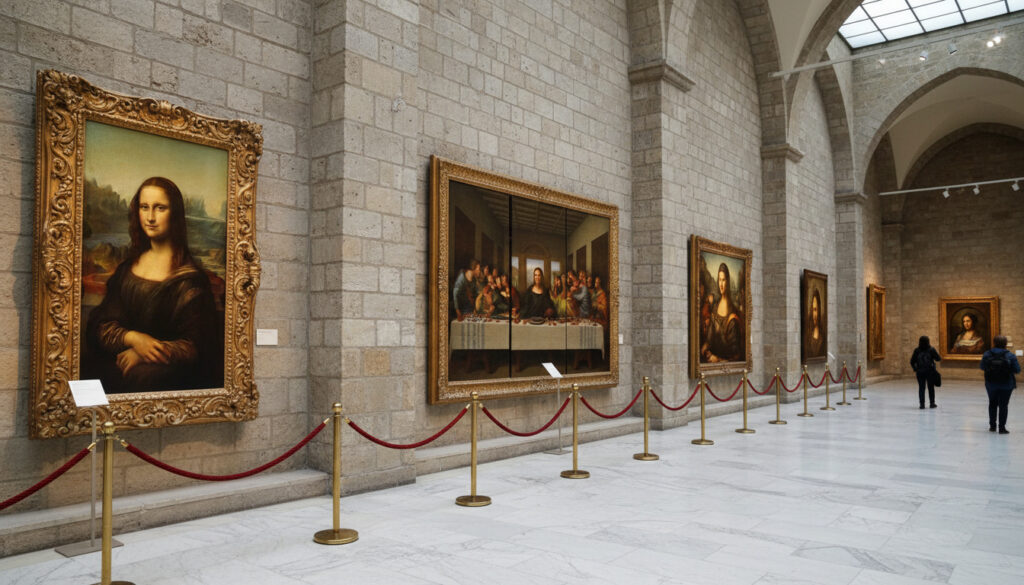
Leonardo da Vinci Paintings – List Locations and Facts
Leonardo da Vinci died in 1519 having completed fewer than ten paintings bearing universal scholarly attribution, a staggeringly small output for an artist widely considered the archetype of the Renaissance genius. This scarcity underscores a lifetime devoted to meticulous observation and experimental technique rather than prolific production. Today, between 20 and 23 works are associated with his hand, though only a core group of approximately eight enjoys undisputed authenticity, while others remain the subject of intense scholarly debate.
The surviving paintings revolutionized Western art through technical innovations like sfumato and anatomical precision rarely seen before the High Renaissance. Masterpieces including the Mona Lisa, The Last Supper, and the controversial Salvator Mundi now reside in museum collections across Europe and North America, attracting millions of viewers annually. Yet many works remain unfinished, abandoned due to Leonardo’s perfectionism or physical limitations in his final years.
Understanding the scope of Leonardo’s painted oeuvre requires navigating complex questions of attribution, restoration, and historical documentation. While early twentieth-century catalogs attributed nearly 100 paintings to him, modern connoisseurship has narrowed this field drastically through scientific analysis and stylistic comparison.
What Are Leonardo da Vinci’s Most Famous Paintings?
c. 1503–1519
Oil on poplar
Louvre, Paris
1495–1498
Tempera on plaster
Santa Maria delle Grazie, Milan
c. 1500
Oil on panel
Private collection
c. 1483–1486
Oil on panel
Louvre, Paris
- Only eight major works carry universal scholarly attribution
- Modern catalogs list 20–23 associated works, down from approximately 100 claimed circa 1900
- The Mona Lisa remained in Leonardo’s possession until his death, never delivered to the commissioning patron
- Salvator Mundi fetched the highest auction price ever recorded for a painting attributed to Leonardo despite ongoing authenticity disputes
- Leonardo’s revolutionary sfumato technique created unprecedented atmospheric depth in portraiture
- Paralysis in his right hand at age 65 contributed to the unfinished state of multiple late works
| Painting | Date | Medium | Location | Attribution Status |
|---|---|---|---|---|
| The Baptism of Christ (with Verrocchio) | c. 1474–1478 | Oil/tempera on poplar | Uffizi, Florence | Widely attributed |
| Annunciation | c. 1472–1475 | Oil on panel | Uffizi, Florence | Widely attributed |
| Ginevra de’ Benci | c. 1474–1478 | Oil on panel | National Gallery of Art, Washington, D.C. | Widely attributed |
| Virgin of the Rocks (Louvre) | c. 1483–1486 | Oil on panel | Louvre, Paris | Universally accepted |
| Lady with an Ermine | c. 1489–1490 | Oil on panel | Czartoryski Museum, Kraków | Widely attributed |
| The Last Supper | 1495–1498 | Tempera on gesso/plaster | Santa Maria delle Grazie, Milan | Universally accepted |
| Mona Lisa | c. 1503–1516 | Oil on poplar | Louvre, Paris | Universally accepted |
| Virgin of the Rocks (London) | c. 1495–1508 | Oil on panel | National Gallery, London | Studio assistance likely |
| The Virgin and Child with Saint Anne | c. 1503–1519 | Oil on poplar | Louvre, Paris | Universally accepted |
| Saint John the Baptist | c. 1513–1516 | Oil on walnut | Louvre, Paris | Universally accepted |
| Salvator Mundi | c. 1500 | Oil on panel | Private collection | Disputed authenticity |
How Many Paintings Did Leonardo da Vinci Complete and Where Are They?
Scholarly consensus identifies approximately eight major works universally accepted as fully autograph, including The Adoration of the Magi, Saint Jerome in the Wilderness, the Louvre Virgin of the Rocks, The Last Supper, The Virgin and Child with Saint Anne and Saint John the Baptist, The Virgin and Child with Saint Anne, and the Mona Lisa. However, broader catalogs now associate between 17 and 23 existing paintings with Leonardo’s studio or hand, accounting for works completed with significant assistance from pupils or those existing only partially in his style.
The geographical distribution of these works centers on European institutions. The Louvre in Paris holds the largest concentration, including the Mona Lisa, both versions of the Virgin of the Rocks discussion (though one is disputed), Saint John the Baptist, The Virgin and Child with Saint Anne, and La Belle Ferronnière. Italian collections retain early works at the Uffizi Galleries in Florence, while The Last Supper remains in situ at the convent of Santa Maria delle Grazie in Milan.
Seventeen paintings are currently viewable in public or semi-public settings worldwide, according to recent museum guides. The Recette Pate a Pizza – Authentic Italian Home Recipe provides cultural context for visitors seeking to understand the Florentine milieu that shaped Leonardo’s early career. Advance reservations are mandatory for viewing The Last Supper due to strict conservation protocols limiting daily visitors.
North American holdings include Ginevra de’ Benci at the National Gallery of Art in Washington, D.C., the only Leonardo painting in the Western Hemisphere accessible to the public. Other significant locations include the Czartoryski Museum in Kraków for Lady with an Ermine, the Hermitage Museum in St. Petersburg for the Benois Madonna, and the Alte Pinakothek in Munich for the Madonna of the Carnation.
Which Leonardo da Vinci Paintings Are the Most Valuable or Disputed?
Salvator Mundi stands as the most financially significant and controversial work attributed to Leonardo, having commanded the highest price ever paid for a painting at auction despite persistent questions regarding its full authorship. The panel depicts Christ as Savior of the World holding a crystal orb, and while some scholars accept it as a late Leonardo possibly finished by assistants, others contest the extent of the master’s direct involvement in the finished work.
Authentication challenges extend beyond the Salvator Mundi to include the Portrait of a Musician, Portrait of Isabella d’Este, and the Madonna Litta, all of which lack the unanimous consensus granted to the core eight masterpieces. Oatmeal Raisin Cookies Recipe – Chewy Soft Bakery Style demonstrates how careful ingredient analysis parallels the technical examination of pigments and underdrawings used to establish attribution in Renaissance workshops.
The London version of Virgin of the Rocks presents a different category of uncertainty; while widely attributed to Leonardo, most scholars acknowledge substantial contributions from his Milanese studio assistants. This contrasts sharply with the Louvre version, which is universally accepted as autograph. Lost works such as Leda and the Swan survive only through copies and sketches, complicating efforts to assess Leonardo’s full painted output.
What Techniques Did Leonardo da Vinci Use in His Paintings?
Leonardo revolutionized oil painting through the development and mastery of sfumato, a technique involving the application of translucent glazes in thin layers to create imperceptible transitions between colors and contours. This method eliminates harsh outlines, producing the soft, atmospheric depth visible in the Mona Lisa’s facial modeling and the smoky background of The Virgin and Child with Saint Anne. The technique derives from the Italian word for smoke, describing the haziness achieved through repeated ultra-thin applications.
Leonardo preferred oil on poplar panel for its smooth surface receptive to layered glazes, though he also worked in tempera for The Last Supper. His anatomical studies of dissection informed the lifelike musculature and skeletal structure visible in his figures, surpassing the technical achievements of his Florentine contemporaries.
The artist’s experimental approach to media often compromised the longevity of his works. The Last Supper, executed in tempera on a dry gesso wall rather than traditional wet plaster, began deteriorating within decades of completion. Similarly, many panel paintings show signs of the artist’s habit of endlessly reworking compositions, applying new layers over years or decades, as evidenced by the Mona Lisa’s stratified paint structure.
By age 65, paralysis in Leonardo’s right hand severely restricted his ability to hold brushes and apply the precise glazes his techniques required. This physical decline explains the unfinished state of the Mona Lisa and other late-career projects, contributing to the remarkably small number of completed paintings attributed to his lifetime.
When Did Leonardo da Vinci Paint His Major Works?
- Early Florentine Period (1470s): Leonardo contributes to The Baptism of Christ with Verrocchio (c. 1474–1478) and paints the Annunciation (c. 1472–1475) and Ginevra de’ Benci (c. 1474–1478), establishing his reputation for psychological portraiture.
- First Milanese Period (1480s): Commissioned by the Confraternity of the Immaculate Conception, Leonardo paints the Louvre version of Virgin of the Rocks (c. 1483–1486) and the portrait of Cecilia Gallerani as Lady with an Ermine (c. 1489–1490).
- High Renaissance Maturity (1490s): In the refectory of Santa Maria delle Grazie, Leonardo executes The Last Supper (1495–1498), the largest of his painted works, depicting the moment of Christ’s announcement of betrayal.
- Florentine Return (1503–1506): Leonardo begins the Mona Lisa (c. 1503) and The Virgin and Child with Saint Anne (c. 1503), works he would continue refining for over a decade.
- French Period (1513–1519): Working under Francis I at Cloux, Leonardo produces his final attributed paintings including Saint John the Baptist (c. 1513–1516), characterized by the saint’s enigmatic smile and pointing gesture that would influence Baroque painting.
Which Leonardo da Vinci Paintings Are Definitely Authentic?
| Established Attribution | Disputed or Studio Works |
|---|---|
| Mona Lisa – Louvre, Paris | Salvator Mundi – Private collection |
| The Last Supper – Milan | Portrait of a Musician – Ambrosiana, Milan |
| Virgin of the Rocks (Louvre) | Portrait of Isabella d’Este – Louvre |
| Saint John the Baptist – Louvre | Madonna Litta – Hermitage |
| The Virgin and Child with Saint Anne – Louvre | Virgin of the Rocks (London) – National Gallery |
| Saint Jerome in the Wilderness – Vatican | Leda and the Swan – Lost (copies only) |
| The Adoration of the Magi – Uffizi | Various workshop compositions |
Why Is the Mona Lisa So Famous?
The Mona Lisa achieved iconic status through a convergence of technical innovation, historical circumstance, and cultural mythology. Leonardo’s sfumato technique creates an unprecedented lifelike quality in the subject’s expression, while the composition’s pyramidal structure and atmospheric perspective broke from the rigid profile portraits common in early Renaissance Florence. The painting’s fame accelerated after its theft from the Louvre in 1911, transforming it from a respected masterwork into a global media phenomenon.
The subject’s identity—traditionally identified as Lisa Gherardini, wife of Florentine merchant Francesco del Giocondo—matters less than Leonardo’s treatment of her presence. He carried the panel with him from Florence to Milan to France, working on it intermittently for over a decade until his death. This perpetual state of revision, combined with the painting’s small scale (77 × 53 cm), creates an intimate viewing experience distinct from the monumental altarpieces of his contemporaries.
What Do Art Historians Say About Attribution?
Scholarly consensus now restricts universal attribution to fewer than ten paintings, a dramatic reduction from the approximately one hundred works attributed to Leonardo circa 1900.
— Consensus of modern connoisseurship as documented in Wikipedia’s List of works by Leonardo da Vinci
Virtually all existing painted works attributable to Leonardo are viewable today in seventeen public or private locations, concentrated primarily in European museum collections.
— The Art Newspaper, 2025
What Is the Lasting Legacy of Leonardo da Vinci’s Painted Oeuvre?
Leonardo’s painted legacy rests upon an extraordinarily small body of work—fewer than ten universally accepted panels—whose influence nonetheless transformed Western visual culture. His fusion of scientific observation with artistic representation established new standards for anatomical accuracy and atmospheric perspective that would dominate Renaissance and Baroque painting for centuries. The surviving works, scattered from Kraków to Washington, D.C., remain essential pilgrimage sites for understanding the transition from medieval iconography to modern naturalism.
Frequently Asked Questions
Is Salvator Mundi a real Leonardo da Vinci painting?
Art historians remain divided. While some experts accept it as a late Leonardo possibly finished by assistants, others question the extent of the master’s direct brushwork. The painting’s record-breaking auction price has intensified rather than resolved these debates.
What happened to Leonardo da Vinci’s unfinished paintings?
Many remain incomplete in their original state, retained by the artist due to his perfectionism or physical paralysis after age 65. Some were completed by workshop assistants, while others like the Adoration of the Magi exist as underdrawings with partial paint layers.
Are there Leonardo da Vinci paintings in the United States?
Yes. The National Gallery of Art in Washington, D.C. holds Ginevra de’ Benci, the only Leonardo painting in the Western Hemisphere accessible to the public. The National Gallery in London holds additional major works.
How long did Leonardo work on the Mona Lisa?
Leonardo began the portrait around 1503 and continued refining it until his death in 1519, carrying it with him through moves to Milan, Rome, and finally France. He never considered it finished, layering glazes over more than a decade.
Why did Leonardo paint so few works?
His experimental techniques required slow drying times between glazes, while his extensive scientific studies and engineering projects divided his attention. Perfectionism led him to abandon paintings he deemed incomplete, and late-life paralysis further reduced his output.
More related posts
 Adam Silver: NBA Commissioner Career, Salary, Health, Stances
 Jose Bautista: Career, Net Worth, Family, and What He’s Doing Now
 Anupam Kher: Children, Wives, Hair Loss, Wife’s Illness
 Jerry O’Connell: Biography, Family, and Stamos Feud
 Dev Patel: Biography, Movies, Net Worth, Relationships
 Mary Berg (Chef): Husband, Ethnicity, and Career Facts
 What Did Ozzy Osbourne Die From – Debunking Death Hoaxes and Health Facts
 Nicki Minaj Citizenship: Is She a US Citizen? Key Facts