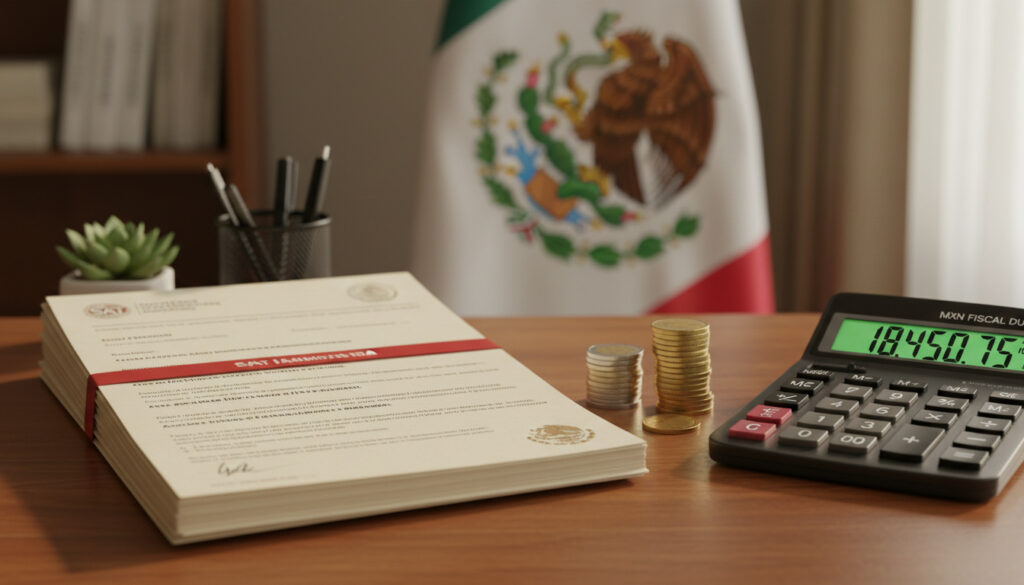
Servicio de Administración Tributaria – SAT Mexico Tax Guide
The Servicio de Administración Tributaria (SAT) operates as Mexico’s federal tax authority, responsible for administering value-added tax, income tax, customs duties, and enforcing compliance across the country’s fiscal system.
Created by decree on December 30, 1996, SAT functions as an autonomous decentralized body under the Secretariat of Finance and Public Credit (SHCP). The agency replaced the previous Treasury Department structure in an effort to modernize revenue collection processes during a period of economic reform and trade liberalization.
For individuals and entities conducting business in Mexico, SAT manages the mandatory tax identification system, digital filing portals, and customs oversight that facilitate approximately 90% of federal government revenues.
What Is the Servicio de Administración Tributaria?
SAT serves as the primary mechanism through which the federal government collects and administers taxes. The agency contributes over 90% of federal revenues through efficient collection systems. Official records indicate that SAT manages key revenue streams including the Impuesto al Valor Agregado (IVA) at 16%, income tax (ISR), and customs duties.
Key Organizational Insights
- Primary federal tax collector generating over 90% of national revenue
- Administers standardized 16% VAT nationwide alongside income and customs taxes
- Operates as an autonomous decentralized entity under SHCP oversight
- Maintains approximately 10,000 staff members with AI-enhanced audit capabilities
- Manages taxpayer identification through the Registro Federal de Contribuyentes (RFC)
- Oversees international trade compliance and fiscal stimulus programs
- Maintains mandatory electronic filing systems initiated in 2014
Institutional Facts
| Full Name | Servicio de Administración Tributaria |
|---|---|
| Abbreviation | SAT |
| Established | December 30, 1996 |
| Official Website | sat.gob.mx |
| Governing Body | Secretariat of Finance and Public Credit (SHCP) |
| Standard VAT Rate | 16% (IVA) |
| Primary Functions | Tax collection, customs administration, compliance verification |
| Digital Platform | SAT Portal (launched 2014) |
What Are the Core Functions and Services?
SAT manages four critical domains of fiscal administration: tax collection, compliance verification, customs operations, and digital service delivery. These functions support Mexico’s economy by ensuring fiscal stability while facilitating international trade.
Tax Collection and Revenue Administration
The agency administers federal taxes including the 16% value-added tax applied uniformly nationwide, income tax (ISR) for individuals and corporations, and special contributions. Documentation confirms that SAT oversees fiscal stimulus programs and economic incentives tied to SHCP policies, ensuring revenues fund federal operations.
Compliance and Verification Systems
Control mechanisms include mandatory filing of declaraciones (tax returns), periodic audits, and real-time reporting requirements. The agency employs artificial intelligence systems to identify discrepancies and enforce compliance among registered taxpayers.
Taxpayers must obtain an e.firma digital signature linked to their RFC to access electronic filing systems, a requirement implemented universally since the 2014 portal modernization.
Customs and International Trade
SAT manages customs duties and international trade compliance through integrated single-window systems. This function proves particularly significant given Mexico’s trade-dependent economy and participation in the USMCA agreement.
How Do Taxpayers Access the SAT Portal?
Accessing SAT services requires navigation of the official digital infrastructure at sat.gob.mx, where taxpayers complete registrations, file declarations, and manage compliance documentation.
Registration and RFC
Individuals and entities must first obtain a Registro Federal de Contribuyentes (RFC) through SAT offices or authorized registration points. This unique tax identification number serves as the primary credential for all subsequent interactions with the fiscal system.
Digital Authentication
The portal requires secure acceso via CURP (Unique Population Registry Code) and RFC registration, coupled with the e.firma digital signature. Users initiate personalized services through the “Inicia sesión” portal, while mobile applications support declaration submissions.
Filing Declarations
The declaraciones portal processes ISR, IVA, and customs filings electronically. System records indicate that the 2014 digital transformation reduced paperwork by 80%, establishing mandatory e-filing for most taxpayer categories.
How Does SAT Compare to the U.S. Internal Revenue Service?
While both agencies serve as primary federal tax collectors, structural and operational differences reflect distinct national fiscal systems. SAT emphasizes digital mandates and customs administration due to Mexico’s trade reliance, while the IRS focuses primarily on complex income tax deductions within a system lacking national VAT.
| Aspect | SAT (Mexico) | IRS (U.S.) |
|---|---|---|
| Establishment | 1996 (decentralized under SHCP) | 1862 (independent Treasury bureau) |
| Primary Tax Scope | VAT (16%), ISR, customs duties | Income tax primary; no national VAT |
| Digital Portal | sat.gob.mx (mandatory e-filing since 2014) | irs.gov (e-file voluntary since 1986) |
| Revenue Share | Approximately 25% of GDP | Approximately 16% of GDP |
| Staffing | Approximately 10,000 employees | Approximately 80,000 employees |
| COVID-19 Response | Digital deferrals, VAT credits, 100% process digitization | Stimulus checks, extended deadlines |
Mexico applies a consistent 16% VAT nationwide without state-level variations, simplifying compliance compared to the multi-jurisdictional sales tax systems found in the United States.
Despite modernization efforts, SAT operates with significantly smaller staffing levels than comparable agencies, relying heavily on automated systems for enforcement and verification.
How Has SAT Evolved Since Its Creation?
The agency’s development reflects Mexico’s economic crises and digital transformation mandates over three decades.
- : Tax administration handled by SHCP’s Treasury arm, criticized for inefficiency during the 1994 peso devaluation crisis.
- : Official creation via Federal Tax Code decree as autonomous decentralized body under SHCP to modernize collection amid NAFTA implementation.
- : Expansion of digital declaration tools; integration of customs operations via single-window systems.
- : Launch of SAT Portal (sat.gob.mx), enabling electronic filings, digital payments, and remote access, reducing paperwork by 80%.
- : Implementation of emergency COVID-19 measures including deferred declarations, VAT credits for affected sectors, and complete digitization of processes.
- : Deployment of AI-driven audit systems and real-time VAT reporting technologies.
What Information Is Definitively Established?
| Established Facts | Information That Remains Unclear |
|---|---|
| Created December 30, 1996 via Federal Tax Code | Specific budget allocations for upcoming fiscal years |
| Contributes over 90% of federal revenue | Complete technical specifications of AI audit algorithms |
| VAT fixed at 16% nationally | Timeline for proposed legislative reforms |
| Mandatory e-filing via sat.gob.mx since 2014 | Detailed staffing projections for future expansions |
| Part of SHCP organizational structure | Specific thresholds for automated audit triggers |
What Is SAT’s Role in Mexico’s Economic Framework?
SAT functions as the central nervous system of Mexican public finance, bridging federal policy and economic implementation. The agency’s collection capabilities determine the government’s capacity to fund infrastructure, social programs, and administrative operations.
During the 1994 economic crisis that preceded SAT’s creation, revenue collection inefficiencies exacerbated fiscal instability. The 1996 reforms aimed to separate tax administration from direct political control while maintaining coordination with SHCP policy directives. This structure allowed Mexico to stabilize revenues during subsequent trade liberalization and the transition to USMCA.
The agency’s customs administration plays a particularly critical role given Mexico’s export-oriented economy. Analysis indicates that efficient customs processing directly impacts supply chain costs for manufacturing sectors. Similar to how Marie-Philip Poulin Barred French – Olympics Press Controversy Explained highlighted protocol complexities in international contexts, SAT navigates complex international trade compliance requirements.
What Are the Authoritative Sources on SAT?
Primary documentation derives from the Federal Tax Code establishing the agency, official SAT publications regarding portal procedures, and Secretariat of Finance directives governing administrative procedures.
The Servicio de Administración Tributaria was officially created by decree on December 30, 1996, as an autonomous decentralized body under the Secretariat of Finance and Public Credit to replace the Treasury Department and modernize tax collection amid NAFTA implementation and fiscal reforms.
— Federal Tax Code documentation
What Should Taxpayers Remember About SAT?
The Servicio de Administración Tributaria stands as Mexico’s mandatory gateway for federal tax compliance, requiring all economically active entities to register, obtain digital credentials, and file through its online portal. While resembling other national tax agencies in function, SAT’s integration of customs administration and its rapid digital transformation distinguish its operational model. For those managing cross-border financial obligations, understanding these mechanisms proves as essential as checking your Winners Gift Card Balance – Check Online, Phone or In-Store for accurate accounting.
Common Questions About SAT
Who is required to register with SAT?
Any individual or entity conducting economic activities in Mexico, including businesses, freelancers, and importers, must obtain an RFC through SAT registration.
What documents are needed for portal access?
Users require their RFC number, CURP (Unique Population Registry Code), and an e.firma digital signature obtained through SAT offices or authorized kiosks.
How does SAT differ from state tax agencies?
SAT manages federal taxes (IVA, ISR, customs) exclusively; state and municipal taxes fall under local jurisdiction outside SAT’s direct administration.
Can foreign businesses use SAT services?
Foreign entities operating in Mexico must register for an RFC and appoint a legal representative to comply with SAT filing requirements and customs procedures.
What happens if I miss a declaration deadline?
Late filings trigger penalties and interest charges calculated on owed amounts; the portal automatically applies these fees to subsequent declarations.
More related posts
 Justin Rose: Family, Friends, and Life on the PGA Tour
 Tyrese Gibson: Divorce, Money Loss, and Fast & Furious
 Leonardo da Vinci Paintings – List Locations and Facts
 Olivia Dunne: Biography, Net Worth, Relationship, and Career
 Emma Grede: Net Worth, Husband, and How She Made Her Money
 Zeev Buium: Age, Ethnicity, Father, and NHL Career
 Tren Twins: Age, Height, Real Names & Net Worth (2024 Guide)
 Thai Red Curry Recipe: 30-Minute Restaurant-Quality Guide