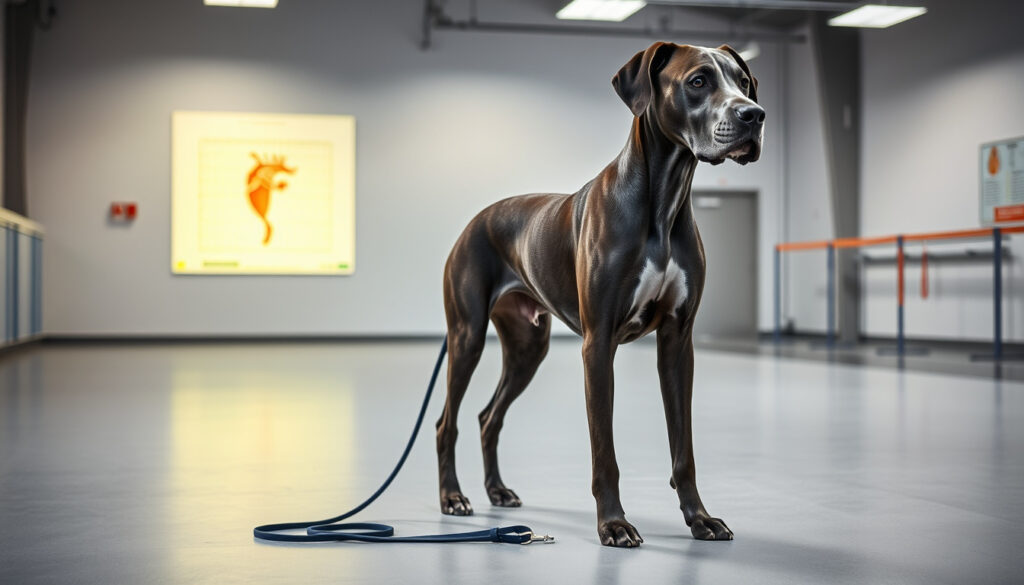
Great Dane temperament, training, and health risks explained
There’s a reason Great Danes are often called “gentle giants” — these dogs pack a lot of love into a frame that can tower over six feet tall on their hind legs. But behind that calm, affectionate expression lies a breed that demands careful, early training and vigilant health management.
Height: 28–34 inches at the shoulder · Weight: 100–200 lbs · Lifespan: 7–10 years · Bloat risk: #1 cause of death · Training need: Early socialization + positive reinforcement
Quick snapshot
- Gentle, quiet, affectionate companion (PetMD)
- Correctly bred Danes have a gentle, loving disposition (Great Dane Club of America)
- High risk of bloat (gastric torsion) — primary killer (Bioguard Labs)
- Prone to hip dysplasia and dilated cardiomyopathy (Bioguard Labs)
- Exact prevalence of tricuspid and mitral valve disease in Danes (Bioguard Labs)
- Whether bloat can be prevented solely by feeding schedule — evidence is mixed (The Farmer’s Dog)
- Long-term effectiveness of early socialization for dominant tendencies (VCA Hospitals)
- Puppy kindergarten (3–6 months) strongly recommended by breed club (Great Dane Club of America)
- Basic obedience class follows puppy kindergarten (Great Dane Club of America)
- Bloat risk peaks after 2 years of age — emergency recognition critical (Bioguard Labs)
- Ongoing research into genetic markers for bloat and heart disease (Bioguard Labs)
- Expanded use of holistic health screenings for early detection in large breed dogs (VCA Hospitals)
Six key facts about the Great Dane — from temperament through health — form the backbone of every owner’s decision.
| Attribute | Detail | Source |
|---|---|---|
| Temperament | Gentle, quiet, affectionate | PetMD |
| Family suitability | Good with children when trained early | PetMD |
| Socialization window | First 4 months — expose to people, pets, stimuli | PetMD |
| Training method | Positive reinforcement recommended | PetMD |
| Breed club stance | Correctly bred Danes have gentle, loving disposition | Great Dane Club of America |
| Puppy class recommendation | Kindergarten classes for 3–6 month olds | Great Dane Club of America |
| Obedience training | Basic obedience class after puppy kindergarten | Great Dane Club of America |
| Adult temperament | Most are calm, quiet pets; some dominant or timid | VCA Hospitals |
| Leadership need | Establish control in puppyhood due to size | VCA Hospitals |
| Bloat risk | Primary killer — red-alert emergency | Bioguard Labs |
| Heart disease | Dilated cardiomyopathy, tricuspid & mitral valve disease | Bioguard Labs |
| Hip dysplasia | Common orthopedic issue | Bioguard Labs |
What is the Great Dane’s true temperament?
The Great Dane is consistently described as a gentle, quiet, and affectionate companion by multiple veterinary sources. The Great Dane Club of America (the breed’s official parent club) states that correctly bred Danes have a gentle and loving disposition. VCA Hospitals (a network of veterinary practices) adds that most adult Danes are calm, quiet pets, though a few can show dominant tendencies or timidity.
A well-bred Great Dane is a reliable family dog, but “well-bred” is the key — temperament is not guaranteed without responsible breeding and early socialization. The dominant or timid minority underscores the need for structured training from puppyhood.
How should you train and socialize a Great Dane?
Training a Great Dane starts with early socialization. PetMD (a trusted veterinary resource) recommends exposing puppies to many new stimuli, including people and pets, within the first four months. The Great Dane Club of America strongly recommends puppy kindergarten classes for dogs three to six months old, followed by a basic obedience class. VCA Hospitals emphasizes establishing leadership and control in puppyhood because of the breed’s large size — a 150-pound untrained Dane is a safety risk.
- Positive reinforcement training is recommended by PetMD and The Farmer’s Dog (a fresh dog food company).
- Crate training helps with potty training and provides a safe space when unsupervised (The Farmer’s Dog).
- At least two or three walks per day are recommended for exercise (The Farmer’s Dog).
What are the biggest health risks for Great Danes?
Bloat — gastric torsion — is the primary killer of Great Danes, according to Bioguard Labs (a veterinary diagnostics company). It is a red-alert emergency requiring surgical intervention. The Farmer’s Dog advises feeding at least twice daily, and possibly three meals, to help prevent bloat. Beyond bloat, the breed is prone to heart diseases: dilated cardiomyopathy, tricuspid valve disease, and mitral valve disease. Hip dysplasia is also common (Bioguard Labs).
A Great Dane that shows signs of restlessness, unproductive retching, or a distended abdomen needs immediate veterinary attention — every hour of delay reduces survival odds. Annual cardiac and hip screenings are recommended for all Danes.
The implication: owning a Great Dane means committing to proactive health monitoring — feeding schedules, observation for bloat symptoms, and regular orthopedic and cardiac checks. Skipping these can turn a gentle giant into a costly emergency.
What do experts say about the breed?
“Great Danes are generally described as gentle, quiet, and affectionate companions. They are typically good family dogs and do well with children when trained and socialized from an early age.”
— PetMD
“Correctly bred Great Danes have a gentle and loving disposition.”
— Great Dane Club of America
“Most Great Danes are calm, quiet pets as adults. However, some can have dominant tendencies and a few can be timid.”
— VCA Hospitals
“Bloat is the primary killer of Great Danes and a red-alert emergency requiring surgical intervention.”
— Bioguard Labs
The pattern across all sources is consistent: the Great Dane is a large, loving dog that demands disciplined training and vigilant health care. The trade-off for a calm, affectionate family companion is the responsibility of managing serious health risks.
youtube.com, webmd.com, ngdc.cncb.ac.cn, myfurtopia.com, breedtools.com, lyka.com.au, pawlicy.com
Frequently asked questions
Are Great Danes good with children?
Yes, when properly trained and socialized from an early age. PetMD notes they are typically good family dogs.
How much exercise does a Great Dane need?
At least two or three walks per day, according to The Farmer’s Dog. Avoid high-impact exercise in puppies to protect joints.
What is bloat in Great Danes?
Bloat (gastric torsion) is a life-threatening condition where the stomach twists on itself. It is the #1 cause of death in Great Danes, per Bioguard Labs.
How can I prevent bloat?
Feed multiple small meals per day, avoid vigorous exercise before and after meals, and consider a slow-feeder bowl. The Farmer’s Dog recommends at least two meals, possibly three.
What heart problems are common in Great Danes?
Dilated cardiomyopathy, tricuspid valve disease, and mitral valve disease. Bioguard Labs lists these as breed-specific concerns.
Do Great Danes need obedience training?
Yes — the Great Dane Club of America recommends puppy kindergarten followed by basic obedience class.
Are Great Danes aggressive?
No. They are generally gentle and affectionate. However, VCA Hospitals notes some can have dominant tendencies, which early socialization and leadership can manage.
How long do Great Danes live?
Typically 7–10 years, shorter than smaller breeds due to their size.
More related posts
 Native American: Who Is Considered and Key Questions
 Russo-Ukrainian War: Latest Updates, Maps & Analysis
 Jose Bautista: Career, Net Worth, Family, and What He’s Doing Now
 Leah Remini: Divorce, Weight Gain, Plastic Surgery Updates
 Ed Sullivan: Cause of Death, Net Worth, Famous Line & More
 Tyra Banks: Biography, Kids, Partner, Net Worth & Controversies
 Where to Find Free Diet Plans: NHS, Mayo Clinic & More
 Area Code 236 Canada: BC Location, Scams and Lookup