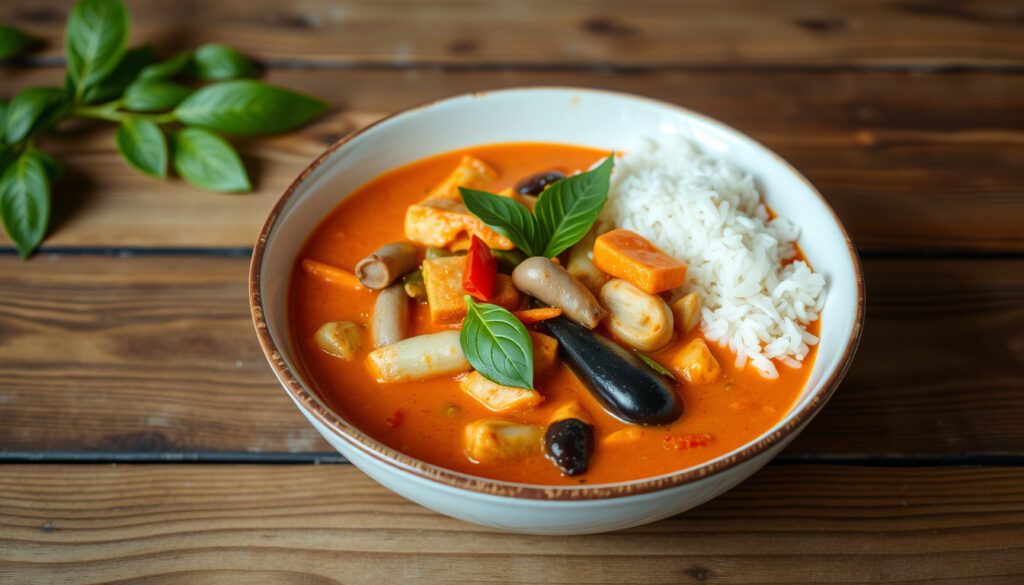
Thai Red Curry Recipe: 30-Minute Restaurant-Quality Guide
Thai red curry tastes like it belongs in a Bangkok restaurant kitchen — rich, deeply spiced, with that slow-building heat that makes you want seconds. Here’s the secret most home cooks don’t realize: you don’t need exotic ingredients or culinary training. A good jar of store-bought paste and a can of coconut milk are enough to build something that genuinely impresses.
Prep Time: 15 minutes · Cook Time: 30 minutes · Servings: 4 · Vegetarian Option: Yes · Key Ingredient: Red Curry Paste
Quick snapshot
- Red curry paste is essential (Hot Thai Kitchen)
- Maeploy is the go-to brand but heavy on salt (Hot Thai Kitchen)
- Full-fat coconut milk is non-negotiable for richness (SueBee Homemaker)
- Exact calorie counts vary by brand and substitutions
- Regional paste variations across Thailand not fully documented
- RecipeTin Eats 30-minute method published (RecipeTin Eats)
- Multiple paste brands reviewed and compared since early 2020s (RecipeTin Eats)
- Your curry on the table in under 45 minutes total
- Store-bought paste optimization leads to restaurant-quality results
Key recipe specifications provide the foundation for authentic Thai red curry preparation.
| Label | Value |
|---|---|
| Origin | Thai cuisine |
| Key Paste | Store-bought red curry paste |
| Base Liquid | Coconut milk |
| Prep Speed | 15 minutes |
What ingredients are in Thai red curry?
Authentic Thai red curry paste includes red chillies, garlic, shallots, lemongrass, galangal, Thai shrimp paste, and kaffir lime peel (Non-Guilty Pleasures). The good news: you don’t need to make it from scratch. Hot Thai Kitchen confirms that store-bought paste works fine — most Thai people don’t make their own curry paste (Hot Thai Kitchen).
Core ingredients
- Red curry paste: 3-5 tablespoons for 1 pound of protein (Hot Thai Kitchen)
- Coconut milk: Use full-fat — low-fat versions lack richness (SueBee Homemaker)
- Protein: Chicken thigh, fish fillet, tofu, or vegetables
- Seasoning: Fish sauce (2 tablespoons) and palm sugar (2-3 tablespoons) (Hot Thai Kitchen)
- Finish: Thai basil leaves and optional red bell pepper for color
Substitutions for dietary needs
- Vegetarian/vegan: Use MaeSri paste (100% vegetarian) and swap fish sauce for soy sauce or coconut aminos (The Modern Proper)
- Vegan option: Aroy-D brand is explicitly vegan-friendly (Hot Thai Kitchen)
- Low FODMAP: Skip the garlic and shallots; use garlic-infused oil instead
What vegetables go well in red curry?
Kabocha squash is the classic pairing in many Thai recipes, adding natural sweetness that balances the paste’s heat (Hot Thai Kitchen). Beyond that, the curry welcomes almost any vegetable that holds its shape during cooking.
Best vegetable pairings
- Kabocha squash: 2 cups works well with 1 pound of chicken (Hot Thai Kitchen)
- Bamboo shoots: Classic texture and mild flavor
- Bell peppers: Red or green, added in the last 5 minutes
- Thai eggplant: Small round eggplants that absorb the curry beautifully
- Green beans: Cut into 2-inch pieces for even cooking
- Baby corn: Adds crunch and visual appeal
Vegetarian recipe tips
For a fully plant-based version, double the vegetables and use firm tofu cubed into 1-inch pieces. Coconut milk provides the protein, and Thai basil adds that signature aromatic finish.
How to make simple red curry?
RecipeTin Eats proves you can pull off restaurant-quality curry in just 30 minutes using store-bought paste (RecipeTin Eats). The method focuses on building flavor in the right order, not in complexity.
One-pot method
- Sauté ginger and garlic for 1 minute in oil (SueBee Homemaker)
- Stir-fry curry paste in oil for 2-3 minutes to release the aroma (YouTube Video)
- Add coconut milk and stir to combine
- Brown chicken pieces for 3 minutes, then add to the curry (Preppy Kitchen)
- Simmer on medium-low heat for 15-20 minutes — do not boil hard (Preppy Kitchen)
- Season with fish sauce and palm sugar to taste
- Finish with Thai basil and serve over jasmine rice
30-minute meal
This timing works because everything happens simultaneously: rice starts cooking first, then you prep the ingredients while the coconut milk simmers. By the time the chicken is cooked through, your rice is ready and the curry is at the perfect consistency.
How to make red Thai curry as good as restaurant?
Good curry starts with good curry paste. If your paste is bland, it’ll be almost impossible to make your curry taste as good as Thai takeout (The Modern Proper). Here’s how to get the most out of store-bought paste.
Using store-bought paste secrets
- Bloom the paste: Fry it in oil for 2-3 minutes until fragrant before adding liquid (YouTube Video)
- Toast slightly: The edges should sizzle and the aroma should bloom — this is non-negotiable
- Adjust seasoning: Boost bland paste with garlic powder, ginger powder, or a pinch of smoked paprika (Preppy Kitchen)
- Salt balance: Maeploy is excellent but heavy on salt — balance with fish sauce, not more sugar
Flavor balance
The standard ratio: 2 tablespoons fish sauce to 2-3 tablespoons palm sugar. Taste as you go — the goal is a harmony of salty, sweet, and spicy. If it’s too salty, add a splash of lime juice. Too sweet, add fish sauce. Too mild, a teaspoon more paste.
Store-bought paste is fine for authentic results. Most Thai home cooks use jarred paste. The difference between your curry and restaurant curry comes down to two things: blooming the paste properly and not overheating the coconut milk.
Thai red curry recipe adaptations
Once you master the base method, the curry adapts to whatever protein or dietary needs you have. The technique stays the same; only the ingredients change.
Chicken version
Use 1 pound chicken thigh, sliced against the grain. Brown for 3 minutes before adding to the curry (Preppy Kitchen). Thigh meat stays juicy longer than breast in the simmer.
Fish version
White fish like cod or tilapia cooks in 5-7 minutes — add it late to avoid overcooking. The curry’s richness complements mild fish perfectly. Salmon works too, though the stronger flavor competes with the paste.
Health tweaks
- Low calorie: Use light coconut milk and increase vegetables
- Low sodium: Choose low-salt paste and skip additional fish sauce
- Low FODMAP: Omit garlic, shallots, and fish sauce; use coconut aminos instead
- Diabetic-friendly: Serve over cauliflower rice instead of jasmine rice; the curry itself has minimal impact when paired with protein and fiber
Thai food triggers digestive issues for some people due to coconut milk’s fat content or spice levels — not the curry itself. If sensitive, start with mild curry paste and full-fat coconut milk (which digests more easily than low-fat alternatives).
Steps section
Three key steps separate good red curry from great red curry. These aren’t complicated techniques — they’re timing and temperature choices that home cooks typically skip.
- Bloom the paste: Fry in oil for 2-3 minutes until deeply fragrant. This releases the essential oils that carry the flavor.
- Never boil hard: Once coconut milk is added, keep it at a gentle simmer. Hard boiling causes curdling and breaks the sauce.
- Build seasoning in layers: Add fish sauce first, then sugar. Taste after each addition. The order matters for balance.
The pattern shows that technique matters more than exotic ingredients for restaurant-quality results.
What we know
- Red curry paste is essential for authentic flavor
- Maeploy and Aroy-D are top-rated store-bought brands
- Full-fat coconut milk produces superior results
- Store-bought paste works for legitimate Thai curry
- 30 minutes is realistic for a weeknight dinner
What remains unclear
- Exact calorie counts without brand-specific testing
- Regional variations across Thailand not fully documented
- Optimal storage duration after opening paste
You do not have to make the curry paste in order to make legit curry, and most Thai people do not make their own curry paste.
— Hot Thai Kitchen (Recipe Author)
Here’s the secret to an AMAZING Thai Red Curry using store bought curry paste in a jar in just 30 minutes.
— RecipeTin Eats (Recipe Author)
For home cooks, the path to restaurant-quality Thai red curry is surprisingly straightforward: pick a solid brand of paste, bloom it properly in oil, treat your coconut milk gently, and season with intention. The shortcuts aren’t shortcuts at all — they’re exactly how Thai people cook at home. Your next weeknight dinner just got more interesting.
Related reading: Traditional Scalloped Potatoes Recipe · Oatmeal Raisin Cookies Recipe
Home cooks aiming for restaurant flavors might also explore easy 30-minute authentic guide, which highlights simple steps and versatile protein options much like this one.
Frequently asked questions
Can I make Thai red curry vegetarian?
Yes. Use MaeSri paste (100% vegetarian), swap fish sauce for soy sauce or coconut aminos, and load up on vegetables like kabocha squash, bell peppers, and bamboo shoots.
What can I substitute for fish sauce?
Soy sauce, coconut aminos, or Worcestershire sauce work as alternatives. For a vegan option, coconut aminos provides similar umami without animal products.
How spicy is Thai red curry?
Medium to hot, depending on the brand. Start with 3 tablespoons paste for mild-moderate heat, or use 4-5 tablespoons for full spice. You can always add more; you can’t remove it.
Does Thai red curry freeze well?
Yes, for up to 3 months. Store in airtight containers with a thin layer of oil on top to prevent oxidation. Thaw overnight in the refrigerator and reheat gently.
What rice pairs best with Thai red curry?
Jasmine rice is the traditional choice — its subtle floral aroma and sticky texture complement the curry’s richness. Thai jasmine has a lower glycemic index than standard long-grain rice.
Is store-bought red curry paste authentic?
Completely authentic. Hot Thai Kitchen confirms most Thai home cooks use store-bought paste. The paste brands Maeploy, Aroy-D, and MaeSri are widely available and produce legitimate results.
How to store leftover Thai red curry?
Refrigerate in an airtight container for up to 4 days. The flavors actually improve overnight as the curry paste melds with the coconut milk. Reheat on the stovetop over medium heat until bubbling.
More related posts
 Adam Sandler: Net Worth, Wife, Movies, and Personality Explained
 Kate McKinnon: Diagnosis, Partner, SNL Exit & Net Worth
 Brooklyn Beckham: Age, Net Worth, and Family Feuds
 Zeev Buium: Age, Ethnicity, Father, and NHL Career
 Florence Pugh: Biography, Relationships, Health, Teeth Facts
 Tommy Shelby: Real Gangster or Fictional Character
 Chase Infiniti: Age, Height, Parents, Relationship, and Real Name
 Russo-Ukrainian War: Latest Updates, Maps & Analysis