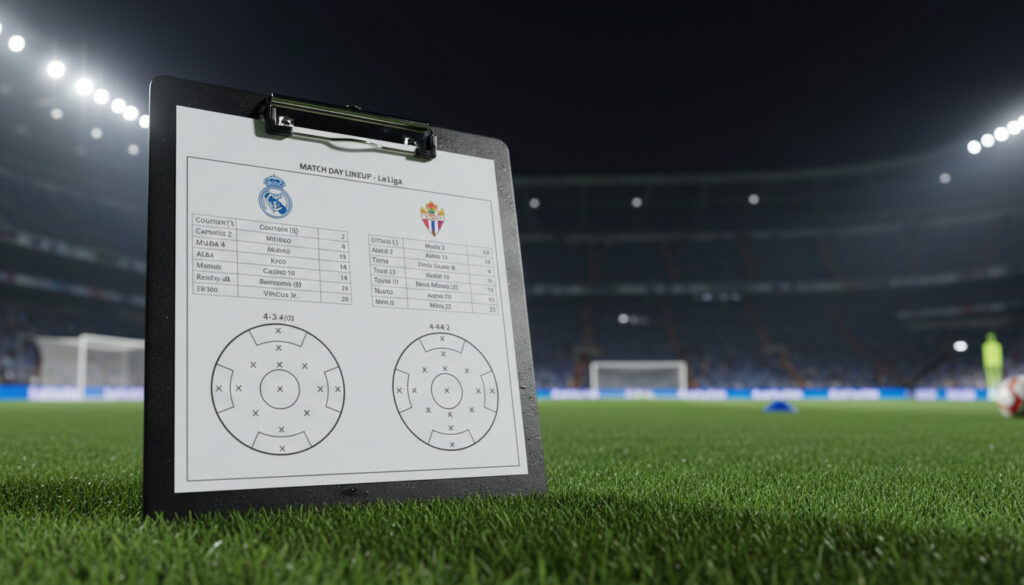
Real Madrid – Celta Vigo Composition – Confirmed Lineups and Team News
Real Madrid secured a crucial 2-1 victory over Celta Vigo on March 6, 2026, at Estadio Abanca-Balaídos, navigating significant injury absences to keep their La Liga title aspirations alive. The Round 27 clash saw Federico Valverde deliver a dramatic stoppage-time winner after Borja Iglesias had temporarily canceled out Aurélien Tchouaméni’s early opener. Manager Álvaro Arbeloa fielded a makeshift side missing several key regulars, while Celta deployed their familiar high-pressing system despite defensive injury concerns.
The composition selections proved decisive in a tense encounter where possession dominance met stubborn resistance. Real Madrid controlled 63% of the ball yet generated only 0.86 expected goals from 14 attempts, highlighting the difficulty of breaking down Celta’s compact defensive structure. Celta Vigo, despite managing just 37% possession and eight shots, registered 1.04 xG through their efficient counter-attacking threat, demonstrating the tactical tightrope both managers walked.
What Were the Predicted Lineups for Real Madrid vs Celta Vigo?
Pre-match predictions converged on several core selections despite injury uncertainties affecting both squads. Analysts anticipated Thibaut Courtois would retain his position between the posts, while defensive debates centered on Raúl Asencio’s fitness following a neck issue sustained in previous weeks.
- Thibaut Courtois was universally expected to start in goal across all predictive models.
- Trent Alexander-Arnold faced scrutiny at right-back following a poor prior outing, yet remained the projected starter.
- Raúl Asencio’s neck injury introduced uncertainty into central defense, with Lamini Fati and Diego Aguado positioned as alternatives.
- Ferland Mendy’s unexpected return to training complicated left-back predictions, where Fran García had been tipped to replace the suspended Carreras.
- Kylian Mbappé’s unavailability forced attacking recalibrations, with Vinícius Júnior anchoring the front line alongside Arda Güler.
- Celta Vigo’s attacking predictions hinged on Borja Iglesias’s return from suspension, the striker having scored 14 goals this season.
- Formation debates focused on whether Arbeloa would deploy a 4-4-2 double pivot or maintain the 4-3-3 structure.
| Team | Formation | Position | Predicted Player | Pre-Match Status |
|---|---|---|---|---|
| Real Madrid | 4-3-3 / 4-4-2 | GK | Thibaut Courtois | Confirmed starter |
| Real Madrid | 4-3-3 / 4-4-2 | RB | Trent Alexander-Arnold | Redemption sought |
| Real Madrid | 4-3-3 / 4-4-2 | CB | Raúl Asencio | Neck injury doubt |
| Real Madrid | 4-3-3 / 4-4-2 | CB | Antonio Rüdiger | Confirmed fit |
| Real Madrid | 4-3-3 / 4-4-2 | LB | Ferland Mendy / Fran García | Carreras suspended |
| Real Madrid | 4-3-3 / 4-4-2 | CM | Aurélien Tchouaméni | Defensive pivot |
| Real Madrid | 4-3-3 / 4-4-2 | CM | Federico Valverde | Box-to-box role |
| Real Madrid | 4-3-3 / 4-4-2 | CAM | Arda Güler | Creative hub |
| Celta Vigo | 3-4-3 | GK | Ionut Radu | Expected starter |
| Celta Vigo | 3-4-3 | CB | Marcos Alonso | Injury doubt |
| Celta Vigo | 3-4-3 | CB | Carl Starfelt | Injury doubt |
| Celta Vigo | 3-4-3 | ST | Borja Iglesias | Returned from suspension |
Sources including AS and Sports Illustrated anticipated Eduardo Camavinga would slot into midfield or left-back despite a dental issue, while Sports Mole highlighted Celta’s defensive injury crisis involving Marcos Alonso and Carl Starfelt.
Confirmed Team Compositions and Starting XI
Official team sheets released approximately one hour before kickoff confirmed the exact eleven players selected by each manager, validating some predictions while surprising observers with several inclusion decisions.
Real Madrid’s Official Lineup
Arbeloa deployed a 4-3-3 formation with Thibaut Courtois in goal; Trent Alexander-Arnold at right-back; Raúl Asencio and Antonio Rüdiger as central defenders; Ferland Mendy at left-back. The midfield trio comprised Federico Valverde, Aurélien Tchouaméni, and Thiago Pitarch. The attacking line featured Brahim Díaz, Arda Güler, and Vinícius Júnior. This selection represented FotMob’s confirmed lineup data.
Celta Vigo’s Official Lineup
Celta maintained their preferred 3-4-3 system with Ionut Radu in goal; Javi Rodríguez, Carl Starfelt, and Marcos Alonso forming the back three. The wing-back positions were occupied by Sergio Carreira and Óscar Mingueza, with Miguel Román and Ilaix Moriba central. The front three consisted of Ferrán Jutglà, Borja Iglesias, and Williot Swedberg. Notably, both Starfelt and Alonso started despite pre-match injury concerns.
Federico Valverde’s strike in the fourth minute of added time proved decisive, securing three points that kept Real Madrid within four points of league leaders Barcelona. The Uruguayan midfielder capitalized on sustained pressure to break Celta resistance after 94 minutes of play.
Team News: Injuries and Suspensions
Both squads navigated significant availability challenges that directly influenced their final compositions and tactical approaches.
Real Madrid’s Absence Crisis
The visitor’s injury list under coach Álvaro Arbeloa created substantial selection headaches. Sports Illustrated confirmed Kylian Mbappé was unavailable for selection, while Rodrygo remained sidelined with an ACL injury. Raúl Asencio had suffered a recent neck issue but returned to training sufficiently to start. Eduardo Camavinga overcame a dental problem to make the bench, potentially offering cover at left-back or midfield. Ferland Mendy’s unexpected return solved the left-back dilemma created by Carreras’s suspension.
Celta Vigo’s Defensive Concerns
Sports Mole documented Celta’s defensive injury issues involving Marcos Alonso, Carl Starfelt, and Pablo Duran. Despite these concerns, both Alonso and Starfelt were declared fit to start the match. The significant boost came from Borja Iglesias’s return from suspension, the 14-goal striker immediately reclaiming his central role in the front three.
Formations and Tactical Setups
The tactical battle pitted Real Madrid’s possession-based approach against Celta’s aggressive high-pressing system, with formation choices reflecting each manager’s strategic priorities.
Real Madrid’s 4-3-3 Execution
Arbeloa maintained the 4-3-3 structure despite speculation favoring a 4-4-2 defensive shield. The double pivot of Tchouaméni and Valverde provided defensive coverage while enabling transitions exploiting the pace of Vinícius Júnior and Brahim Díaz. Thiago Pitarch operated as the advanced midfielder linking to the front three. AS noted this represented continuity from previous setups despite the Getafe loss.
Celta Vigo’s High-Pressing 3-4-3
Celta deployed their familiar 3-4-3 formation with wing-backs Mingueza and Carreira providing width. The high-pressing style intentionally left spaces behind the defensive line, creating opportunities for rapid counter-attacks through Jutglà and Swedberg flanking Iglesias. This aggressive posture had secured four straight wins entering the match, including a 2-0 home victory over Real Madrid earlier this season.
Match data reveals a stark contrast in efficiency. Real Madrid dominated with 63% possession and 14 shots but generated only 0.86 expected goals. Celta Vigo converted 37% possession and 8 attempts into 1.04 xG, demonstrating superior attacking efficiency despite territorial disadvantage.
The absence of Mbappé and Rodrygo removed approximately 25 goals from Real Madrid’s available attacking resources, necessitating reliance on younger attacking midfielders Güler and Brahim to support Vinícius Júnior’s lone striking role.
Match Day Timeline: From Predictions to Final Whistle
- Pre-Match Predictions: Analysts release projected lineups suggesting Mendy might miss out and Asencio would face late fitness tests. Source: Sports Mole
- Injury Updates: Reports confirm Camavinga’s dental issue has resolved, while Celta’s Starfelt and Alonso pass late fitness tests to start. Source: AS
- Official Confirmation: Clubs submit final team sheets confirming the 4-3-3 and 3-4-3 formations with all injury doubts cleared. Source: FotMob
- 11th Minute: Aurélien Tchouaméni opens the scoring for Real Madrid. Source: FotMob
- 25th Minute: Borja Iglesias equalizes for Celta Vigo against his former employers. Source: FotMob
- 90+4th Minute: Federico Valverde scores the winning goal in stoppage time. Source: FotMob
- Post-Match: Victory maintains Real Madrid’s second position with 60 points, four behind Barcelona. Source: Athlon Sports
Clarity Check: Established Facts and Pre-Match Uncertainties
Verified Information
- Final score: Real Madrid 2-1 Celta Vigo
- Confirmed formations: 4-3-3 (Real) and 3-4-3 (Celta)
- Goal scorers: Tchouaméni (11′), Iglesias (25′), Valverde (90+4′)
- Definitive absences: Mbappé (unavailable), Rodrygo (ACL), Carreras (suspended)
- Possession statistics: 63% Real, 37% Celta
- Shot counts: 14 (Real), 8 (Celta)
Pre-Match Uncertainties
- Asencio’s neck injury recovery timeline remained unclear until matchday
- Mendy’s fitness status was unexpectedly positive, surprising observers
- Camavinga’s dental issue created temporary doubts about midfield depth
- Celta’s defensive injury trio (Alonso, Starfelt, Duran) created selection unpredictability
- Whether Arbeloa would switch to 4-4-2 remained speculative until team sheet release
Title Race Context and Historical Stakes
The fixture carried significant weight in the championship chase. Athlon Sports noted Real Madrid entered the match on the back of consecutive LaLiga defeats, having dropped to second place with 60 points from 19 wins, three draws, and four losses. The four-point deficit to Barcelona made this a must-win proposition to prevent the gap from widening further.
Celta Vigo arrived with formidable momentum, having secured four consecutive victories including a 2-0 home triumph over Real Madrid earlier in the campaign. Their 3-4-3 system’s effectiveness against possession-heavy opponents had been established, raising tactical questions about Arbeloa’s ability to adapt his composition to counter the high press.
The connection between lineup decisions and sporting outcomes extends beyond football. The Marie-Philip Poulin Olympics Controversy demonstrated how roster selections and eligibility decisions generate similar analytical interest across competitive disciplines, though the specific pressures differ between club football and international tournament regulations.
Source Verification and Attribution
All lineup compositions and match events reported here derive from official match data providers and established sporting publications. FotMob provided definitive team sheet confirmation and statistical analysis including expected goals metrics. Spanish publication AS contributed pre-match predictive analysis and tactical formation speculation. Sports Illustrated and Sports Mole furnished detailed injury reporting and availability updates. Athlon Sports supplied broader championship context and form analysis.
FotMob’s live match data confirmed Valverde’s 90+4th minute winner and the definitive starting elevens for both clubs.
— FotMob Match Center
AS analysis indicated Arbeloa would likely maintain recent structural setups despite the Getafe defeat, prioritizing continuity over reactive changes.
— AS Sports Desk
Key Takeaways on Team Compositions
Real Madrid’s injury-depleted lineup successfully navigated a tactically complex away fixture through disciplined execution of the 4-3-3 formation and late individual quality from Valverde. Celta Vigo’s defensive injury doubts proved manageable as Starfelt and Alonso both completed the full match, though the result ended their four-match winning streak. The composition choices validated Arbeloa’s decision to retain structural consistency while highlighting the squad depth challenges facing defending champions with multiple attacking absences. Analysis of touring musician roster changes, such as examining the Five Finger Death Punch Members, reveals similar patterns of strategic personnel management under resource constraints.
Frequently Asked Questions
Where can I watch Real Madrid vs Celta Vigo lineup announcements?
LaLiga Santander matches are broadcast through official league partners including ESPN and regional sports networks, with lineup announcements typically released one hour before kickoff on club social media channels and sports data platforms like FotMob.
How do live updates on team composition work?
Real-time lineup confirmations appear through verified sports data aggregators approximately 60 minutes before kickoff, with injury updates and bench announcements filtering through throughout the match day via club communications and pitch-side reporters.
Which bench players impacted the Real Madrid Celta match?
Eduardo Camavinga overcame a dental issue to provide midfield and left-back cover from the substitutes, while Celta’s Pablo Duran remained unavailable through injury despite earlier hopes of defensive reinforcement.
Why was Kylian Mbappé unavailable for this fixture?
Club sources confirmed Mbappé was unavailable for selection against Celta Vigo, though specific reasons beyond general squad management were not publicly detailed by manager Álvaro Arbeloa in pre-match communications.
What formation differences emerged between prediction and reality?
While analysts speculated Arbeloa might switch to 4-4-2 for defensive solidity, the confirmed lineup maintained the 4-3-3 structure with Thiago Pitarch as the advanced midfielder rather than a flat four-man midfield.
How did Celta Vigo’s injury doubts resolve?
Despite pre-match uncertainty documented by Sports Mole regarding Marcos Alonso and Carl Starfelt, both defenders completed the full 90 minutes in the back three, with only Pablo Duran remaining sidelined among the defensive injury concerns.
More related posts
 Taylor Kinney: Relationship, Career, and Life After Lady Gaga
 Salt Bae Decline: Closures, Net Worth, World Cup Controversy
 Philip Seymour Hoffman: Cause of Death & Final Movies
 Arthur Jones Cause of Death – Natural Causes at Age 80
 Tatsu Sushi + BBQ All You Can Eat Menu – Prices, Items, AZ Locations
 Kevin Federline’s Life After Britney: Fatherhood & Memoir
 Loop and Thread Yarn: Complete Guide to Michael ‘ Hou e Brand
 How Old Is Donald Trump? Birth Date, Age and Presidential Records