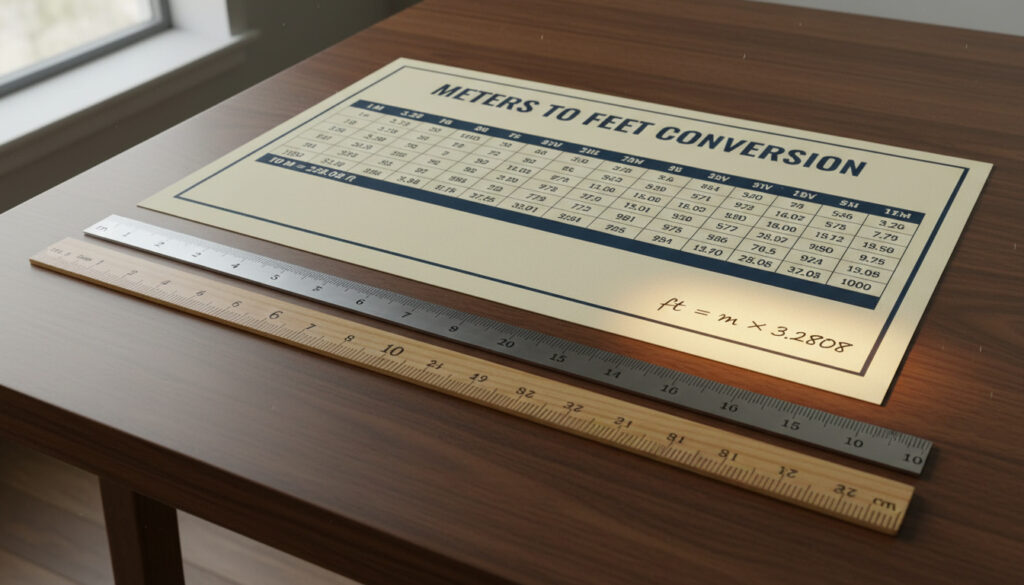
Convert M to Ft – Exact Formula, Chart and Guide
Converting meters to feet remains a daily necessity for engineers, architects, and travelers navigating between metric and imperial systems. One meter equals exactly 3.280839895 feet, a ratio fixed by international agreement in 1959 and maintained by metrological authorities worldwide.
The conversion bridges the International System of Units (SI) and the imperial system, which still prevails in the United States and partially in the United Kingdom. Understanding the precise relationship prevents costly errors in construction, aviation, and scientific research where exactitude matters.
The following sections provide the exact conversion factor, manual calculation methods, reference charts, and digital tools to convert meters to feet accurately in any context.
How Many Feet Are in a Meter?
1 m = 3.280839895 ft
Multiply meters by 3.28084
1959 International Yard and Pound Agreement
1 ft = 0.3048 m
- The conversion factor is exact and unrounded, defined by the 1959 treaty.
- The National Institute of Standards and Technology (NIST) and BIPM maintain this standard.
- For mental calculations, 3.28 provides sufficient precision for most purposes.
- One meter equals approximately 3 feet 3⅜ inches when broken down imperially.
- The definition makes the foot exactly 0.3048 meters, fixing previous variations.
- No country uses a different ratio; the conversion is globally standardized.
- Engineering tolerances often require the full 3.280839895 factor.
| Meters | Feet | Common Context |
|---|---|---|
| 0.01 | 0.0328 | Precision measurement |
| 0.1 | 0.3281 | Small objects |
| 1 | 3.2808 | Base unit |
| 2 | 6.5617 | Human height |
| 5 | 16.4042 | Room dimensions |
| 10 | 32.8084 | Building floors |
| 20 | 65.6168 | Swimming pools |
| 50 | 164.042 | Athletic fields |
| 100 | 328.084 | Urban blocks |
Meters to Feet Conversion Formula
The Multiplication Method
Converting meters to feet requires multiplying the length in meters by 3.280839895. For example, 5 meters multiplied by this factor equals 16.404199475 feet. Video tutorials demonstrate this calculation using standard calculators.
Quick Approximation Techniques
When precision is less critical, multiplying by 3.28 yields results accurate to within hundredths of a foot. For rough mental math, using 3.3 provides a close estimate—2 meters becomes approximately 6.6 feet. Mental math strategies suggest this 3.3 multiplier for field estimates.
Converting Feet Back to Meters
The reverse conversion requires multiplying feet by 0.3048. Alternatively, dividing the foot measurement by 3.280839895 returns the exact meter equivalent. Online calculators automate both directions using these exact factors.
For converting common human heights, remember that 1.8 meters equals approximately 5 feet 11 inches, and 2 meters equals roughly 6 feet 6 inches. These benchmarks help verify calculator results instantly.
Meters to Feet Chart and Common Examples
Human Height Conversions
Medical and athletic contexts frequently require converting body measurements. One meter equals 3 feet 3⅜ inches. Thus, a height of 1.8 meters converts to 5 feet 10⅞ inches, commonly referenced as 5 feet 11 inches in practice. Detailed breakdowns show the inch remainders for clinical precision.
Architectural and Construction Measurements
Building plans often specify room dimensions in meters for international projects. A 5-meter living room spans 16 feet 4⅞ inches, while a 10-meter structure extends 32 feet 9¹¹⁄₁₆ inches. Conversion tables provide these values for standard building modules.
Alternative Dimensional Analysis
Alternative dimensional analysis approaches convert meters to kilometers, then to miles, then to feet, as demonstrated in educational conversion tutorials. This method yields identical results: 2.6 meters equals approximately 8.53 feet.
When exact imperial measurements matter, note that 1 meter equals 3 feet 3 3/8 inches. The 3/8 inch fraction derives from the decimal remainder 0.280839895 feet multiplied by 12 inches per foot.
Online Meters to Feet Converter Tools
Digital converters eliminate manual calculation errors. Tools like BYJU’S Meter to Feet Calculator and Calculator Soup apply the 3.280839895 factor automatically, displaying results to customizable decimal places. These platforms serve engineers, students, and professionals requiring immediate conversions without reference tables.
Always verify that online tools use the 1959 international standard factor of 3.280839895. Some deprecated calculators may use rounded 3.28 factors exclusively, potentially introducing errors in precision engineering applications.
History of the Meter-Foot Standard
Understanding the 1959 standardization clarifies why modern conversions remain consistent across all applications.
- : The International Yard and Pound Agreement defines 1 yard as exactly 0.9144 meters, fixing 1 foot at exactly 0.3048 meters.
- : The United States National Bureau of Standards (now NIST) adopts the exact 0.3048 meter foot definition.
- : The British Standards Institution aligns with the international agreement, eliminating previous UK/US foot discrepancies.
- : BIPM maintains these definitions under the SI system, with no proposed changes to the meter-foot relationship.
Established Facts and Common Uncertainties
| Established Information | Information That Remains Unclear |
|---|---|
| 1 meter = 3.280839895 feet (exact) | None—the conversion is mathematically fixed globally |
| 1 foot = 0.3048 meters (exact) | No variation between countries or industries |
| Defined by 1959 International Yard and Pound Agreement | No pending revisions to the standard |
| Recognized by NIST and BIPM | No alternative conversion methods authorized |
Practical Context and Applications
Aviation altimeters display heights in feet globally, requiring pilots to convert metric weather reports. Similarly, 70 Fahrenheit to Celsius – Exact Conversion and Guide demonstrates how imperial-metric conversions permeate meteorology. Construction firms working on international projects must reconcile architectural drawings in meters with imperial building materials sized in feet and inches.
The conversion also appears in athletics, where track events measured in meters must translate to imperial equivalents for American audiences. Scientific research papers using SI units require conversion for public communication in countries retaining imperial customs.
Sources and Metrological Authority
The foot is exactly 0.3048 meter, as established by the 1959 international yard and pound agreement adopted by NIST and BIPM under the metric system’s influence.
— International Bureau of Weights and Measures (BIPM) standards documentation
Primary metrological authorities including the National Institute of Standards and Technology maintain the exact 0.3048 meter foot definition. The BYJU’S educational platform and Calculator Soup implement these standards in consumer calculators.
Summary
One meter equals exactly 3.280839895 feet, established by the 1959 International Yard and Pound Agreement and maintained by NIST and BIPM. Multiplying any meter value by this factor yields precise feet conversion, while 3.28 suffices for general estimates. For related financial conversions, see Us to Canadian Conversion – Live Rate and Charts.
Frequently Asked Questions
How many feet are in one meter exactly?
One meter equals exactly 3.280839895 feet. This value is fixed by international agreement and used by all metrological standards bodies.
What is the formula to convert meters to feet?
Multiply the meter measurement by 3.280839895. For example, 10 meters × 3.280839895 = 32.80839895 feet.
How do I convert 2 meters to feet?
Two meters equals 6.56167979 feet, or approximately 6 feet 6¾ inches when converted to feet and inches.
What is 1.8 meters in feet and inches?
1.8 meters converts to 5 feet 10⅞ inches, commonly rounded to 5 feet 11 inches in practical usage.
How do I convert feet back to meters?
Multiply the foot measurement by 0.3048, or divide by 3.280839895. Both methods yield the exact meter equivalent.
Is 3.28 accurate enough for construction?
For most construction, 3.28 provides sufficient precision. However, structural engineering requiring tight tolerances should use the full 3.280839895 factor.
Are meters and feet the same in every country?
The meter is a universal SI unit. The foot is standardized at exactly 0.3048 meters globally, though the United States and Myanmar primarily use imperial measurements.
Where does the conversion factor come from?
The 1959 International Yard and Pound Agreement defined the yard as 0.9144 meters, making the foot exactly 0.3048 meters and establishing the 3.280839895… conversion factor.
More related posts
 Scott Galloway Net Worth, Biography, and Famous Quotes
 Kathy Hilton Net Worth: How She Compares to Kyle Richards
 Walton Goggins: Biography, Tragedy, and Career Highlights
 Kyle Lowry: Retirement, Net Worth, Career Stats, and More
 Adam Sandler Net Worth 2026: $440M Fortune Breakdown
 Pauly Shore Health Scare: Diagnosis, Tumor, and His Career
 Christiane Amanpour: Health, Husband, Net Worth & More
 Dev Patel: Biography, Movies, Net Worth, Relationships