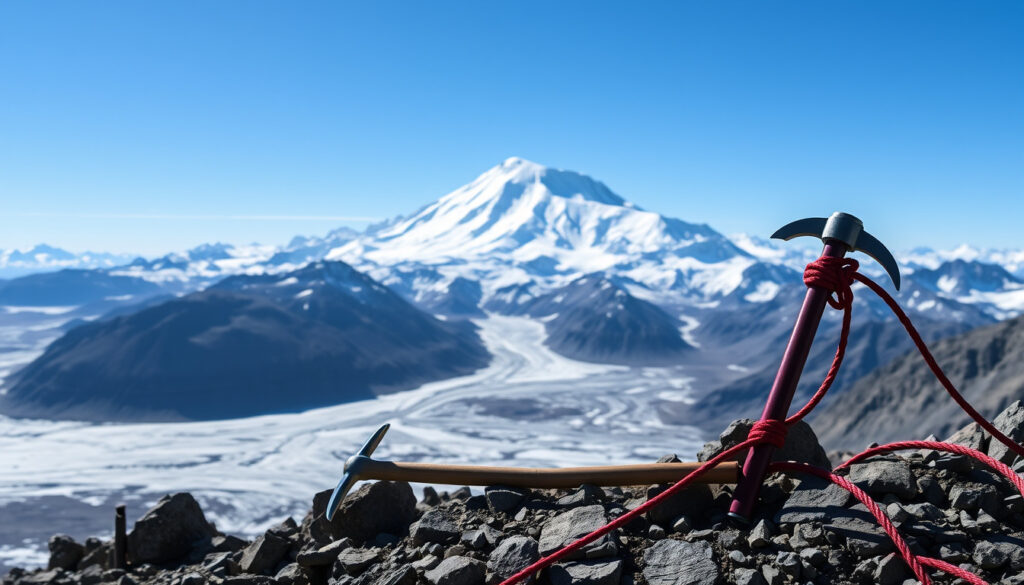
Denali Mountain: Facts, History, and Climbing Guide
There aren’t many mountains that spark a debate about politics, culture, and climbing all at once — but Denali isn’t just any peak. At 20,310 feet, it’s the tallest mountain in North America, yet its name has shifted between honoring an Ohio president and reflecting Alaska Native heritage.
Elevation: 20,310 feet (6,190 m) · Location: Alaska Range, Alaska, USA · First ascent: 1913 (Hudson Stuck, Harry Karstens, Walter Harper, Robert Tatum) · Official names: Denali (federal) / Mount McKinley (historical) · North America rank: Highest peak · Typical climb duration: 2-3 weeks
Quick snapshot
- Denali is the highest mountain in North America at 20,310 ft (Wikipedia (community encyclopedia))
- Federal name was changed to Denali in August 2015 (U.S. Department of the Interior (federal agency))
- President Trump did not reverse the 2015 name change (Wikipedia (community encyclopedia))
- Denali climb is more technically demanding due to cold and snow (National Park Service (federal park agency))
- Whether a future U.S. president will attempt to revert the name (Wikipedia (community encyclopedia))
- Exact number of annual climbers (estimates around 1,200–1,500 summit attempts) (National Park Service (federal park agency))
- Precise meaning of “Denali” in Koyukon (varies between “the high one” and “the great one”) (Camp Denali (Alaskan guiding company and lodge))
- Success rate for amateur climbers without guided support is not firmly documented (National Park Service (federal park agency))
- Pre-1896: Known as Denali by Koyukon Athabascans (Wikipedia (community encyclopedia))
- 1896: Named Mount McKinley by gold prospector William Dickey (Cow Creek Tribal Council (Alaska Native government))
- 1913: First successful ascent (Wikipedia (community encyclopedia))
- 1975: Alaska Legislature officially names it Denali (Wikipedia (community encyclopedia))
- 2015: Federal name changed to Denali by Secretary Jewell (U.S. Department of the Interior (federal agency))
- 2017: Trump order does not affect Denali name (Wikipedia (community encyclopedia))
- Present (2025): Federal name remains Denali (U.S. Department of the Interior (federal agency))
- Future presidential administrations could revisit the naming issue (Wikipedia (community encyclopedia))
- Climate change is affecting glacier stability on the mountain (National Park Service (federal park agency))
- Growing interest in guided commercial expeditions may increase permit demand (National Park Service (federal park agency))
Nine key specs that define the mountain:
| Label | Value |
|---|---|
| Official name (federal) | Denali |
| Historical name | Mount McKinley |
| Elevation | 20,310 ft (6,190 m) |
| Prominence | 20,194 ft (6,155 m) |
| Parent range | Alaska Range |
| First ascent | June 7, 1913 |
| First ascensionists | Hudson Stuck, Harry Karstens, Walter Harper, Robert Tatum |
| National park | Denali National Park and Preserve |
| Longest climbing route | West Buttress (most popular) |
Why Did Mount Denali Change to Mount McKinley?
The 1896 naming after President McKinley
In 1896, a gold prospector named William Dickey coined the name Mount McKinley after then-presidential candidate William McKinley (Cow Creek Tribal Council (Alaska Native government)). McKinley later became the 25th president and was assassinated in 1901 (Cow Creek Tribal Council (Alaska Native government)). The name stuck for more than a century despite the mountain having been called Denali by Koyukon Athabascans for generations. The federal name stood until 2015, when Secretary of the Interior Sally Jewell officially changed it back to Denali (U.S. Department of the Interior (federal agency)). The move came just before President Obama’s Alaska visit in September 2015 and drew immediate criticism from Ohio Republicans (Wikipedia (community encyclopedia)).
The mountain was named for a man who never saw it and had no connection to Alaska. Alaska Natives, mountaineers, and the state itself had long preferred Denali — yet federal politics kept the McKinley name in place for 119 years.
The 2015 federal name change under President Obama
The 2015 change was a direct federal action to correct what many viewed as a colonial imposition. The U.S. Department of the Interior’s decision noted that McKinley never visited the mountain and had no significant historical connection to it (U.S. Department of the Interior (federal agency)). The federal change ended a 40-year standoff, though Ohio politicians have occasionally floated reversal bills.
The Denali–Mount McKinley naming dispute summary
The conflict is between Alaska Native place-name usage and federal commemorative naming. The naming dispute is rooted in a conflict between Alaska Native place-name usage and federal commemorative naming honoring William McKinley (U.S. Department of the Interior (federal agency)). Alaska had already called the mountain Denali since 1975, when the state board changed the name (Wikipedia (community encyclopedia)).
What Is Special About Denali Mountain?
North America’s highest peak
Standing at 20,310 feet (6,190 m), Denali is the tallest mountain on the continent (National Park Service (federal park agency)). Its elevation is measured from sea level, but what makes it truly towering is its vertical rise: about 18,000 feet from base to summit (National Park Service (federal park agency)). That’s over 8,000 feet more than the base-to-summit rise of the highest Himalayan peaks like Everest.
For a climber, the 18,000-foot rise from the tundra to the summit means nearly a vertical mile more hiking than what Everest’s base camp offers — and that’s before accounting for the cold.
Extreme weather and altitude
Denali’s weather is notoriously harsh. Temperatures on the upper mountain can drop to -75°F (-60°C) with wind chills far lower (National Park Service (federal park agency)). The mountain’s latitude (63°N) means thinner air passes over it more slowly, reducing the body’s ability to acclimatize compared to equatorial peaks. This combination of altitude, latitude, and severe cold makes Denali an extreme environment for even experienced mountaineers.
- Average summit temperature: -15°F to 0°F in summer (National Park Service (federal park agency))
- Wind speeds often exceed 50 mph on the upper mountain (National Park Service (federal park agency))
The pattern: Denali forces climbers to fight both altitude and Arctic-grade cold, a rare combination that pushes the body to its limits.
Unique wildlife and geology
Denali lies within Denali National Park and Preserve, a 6-million-acre protected area home to grizzly bears, caribou, moose, wolves, and Dall sheep (National Park Service (federal park agency)). The mountain itself is composed primarily of granite, shaped by massive glaciers that cut through the Alaska Range. Its geological isolation — no other 20,000-foot peak within hundreds of miles — adds to its imposing presence.
Is Denali Harder Than Everest?
Denali is often considered more technically challenging than Everest for a variety of reasons. While Everest is taller, Denali’s weather, snow conditions, and logistic demands can push climbers to their limit.
Five differences, one pattern: Denali penalizes mistakes more severely because rescue is slow and weather windows are extremely narrow.
| Factor | Denali | Mount Everest |
|---|---|---|
| Elevation (sea level) | 20,310 ft (6,190 m) | 29,032 ft (8,849 m) |
| Vertical rise (base to summit) | ~18,000 ft (5,486 m) | ~12,000 ft (3,657 m) |
| Typical climb duration | 2–3 weeks | 6–9 weeks (Wikipedia (community encyclopedia)) |
| Average summit temperature (summer) | -15°F to 0°F | -2°F to -20°F (at extreme altitude) |
| Success rate (guided groups) | ~50–60% | ~60–70% (above Camp IV) |
The colder temperatures and heavy snowfall on Denali create serious crevasses and avalanche risks. All climbers must be proficient in glacier travel, rope crevasse rescue, and winter camping (National Park Service (federal park agency)). The longer approach — hauling sleds of gear for days — also tests endurance.
Is Denali Taller Than Everest?
This is a common source of confusion. By official measurement — elevation above sea level — Everest is taller at 29,032 feet. Denali is 20,310 feet (National Park Service (federal park agency)). But if you measure from base to summit, Denali rises about 18,000 feet compared to Everest’s ~12,000 feet, because Denali sits on a relatively low plateau while Everest rises from the high Tibetan Plateau (Wikipedia (community encyclopedia)).
Another way to view it: Denali has a prominence of 20,194 feet — meaning it is the third most prominent peak in the world, after Everest and Aconcagua (Wikipedia (community encyclopedia)). Prominence measures the mountain’s independent height above all surrounding peaks.
When people ask “which is taller?” they usually mean sea-level elevation, which gives Everest the crown. But if you’re talking about the physical elevation gain a climber must overcome, Denali is more demanding in raw vertical feet.
Can a Normal Person Climb Denali?
Yes, but it requires serious preparation. “Normal” here means a person in excellent physical condition with prior glacier climbing experience and the right gear. Most climbers train for months focusing on cardiovascular endurance, strength, and altitude conditioning (National Park Service (federal park agency)).
- Prerequisites: Experience with rope teams, crevasse rescue, and winter camping (National Park Service (federal park agency))
- Training: Cardio 4–6 days/week, weighted pack hikes, altitude simulation
- Logistics: Permits, sledges, and a 2–3 week itinerary; guided expeditions start around $8,000–$12,000
Guided companies such as Alpine Ascents and Madison Mountaineering are established operators in the region (Alpine Ascents (professional guiding company)). Climbers must submit proof of prior glacier climbing experience or complete a prerequisite course.
Success rates on Denali hover around 50–60% for guided groups, according to National Park Service data. Weather and individual fitness are the biggest variables.
Timeline: Key Dates in Denali’s Naming and Climbing History
- Pre-1896: Mountain known as Denali (Koyukon Athabascan for “the high one”) (Cow Creek Tribal Council (Alaska Native government))
- 1896: Gold prospector William Dickey names it Mount McKinley after presidential candidate William McKinley (Cow Creek Tribal Council (Alaska Native government))
- 1913: First successful summit by Hudson Stuck, Harry Karstens, Walter Harper, Robert Tatum (Wikipedia (community encyclopedia))
- 1975: Alaska Legislature officially names it Denali (Wikipedia (community encyclopedia))
- August 28, 2015: Secretary of the Interior Sally Jewell changes federal name to Denali (U.S. Department of the Interior (federal agency))
- 2017: President Trump issues executive order that does not affect Denali’s name (Wikipedia (community encyclopedia))
- Present (2025): Federal name remains Denali; state of Alaska uses Denali (U.S. Department of the Interior (federal agency))
Clarity: What We Know and What We Don’t
Confirmed facts
- Denali is the highest mountain in North America at 20,310 ft (Wikipedia (community encyclopedia))
- Federal name was changed to Denali in August 2015 (U.S. Department of the Interior (federal agency))
- President Trump did not reverse the 2015 name change (Wikipedia (community encyclopedia))
- Denali climb is more technically demanding due to cold and snow (National Park Service (federal park agency))
What’s unclear
- Whether a future U.S. president will attempt to revert the name (Wikipedia (community encyclopedia))
- Exact number of annual climbers (estimates around 1,200–1,500 summit attempts) (National Park Service (federal park agency))
- Precise meaning of “Denali” in Koyukon (varies between “the high one” and “the great one”) (Camp Denali (Alaskan guiding company and lodge))
- Success rate for amateur climbers without guided support is not firmly documented (National Park Service (federal park agency))
Perspectives from the Mountain
“This is a very special day, and it’s a long time coming. The name Denali reflects the traditions of Alaska’s Native peoples and the heritage of the state.”
— Sally Jewell, U.S. Secretary of the Interior, August 2015 (U.S. Department of the Interior (federal agency))
“It was with deep gratitude that we stood at last upon the highest point of our continent.”
— Hudson Stuck, leader of the first ascent, 1913 (Wikipedia (community encyclopedia))
“The naming of the mountain after a president who never visited Alaska was a colonial act. The 2015 change corrected a historical wrong.”
— National Park Service history page (paraphrased from official communications) (National Park Service (federal park agency))
Did Donald Trump or Obama Change the Name of Denali?
The 2015 Obama-era name change
President Obama directed the name change in August 2015. The U.S. Department of the Interior’s 2015 decision noted that McKinley never visited the mountain and had no significant historical connection to it (U.S. Department of the Interior (federal agency)). The move drew immediate criticism from Ohio Republicans (Wikipedia (community encyclopedia)).
Trump’s 2017 order and its impact
President Trump issued an executive order in 2017 but it did not affect Denali’s name (Wikipedia (community encyclopedia)).
Current official naming status
As of 2025, the federal name remains Denali. The state of Alaska officially uses Denali since 1975 (U.S. Department of the Interior (federal agency)). The implication: despite political noise, the name Denali is stable at the federal level.
Summary: What Denali’s Dual Identity Means for You
Denali is more than a record — it’s a symbol of how geography, culture, and politics collide. The naming dispute is not settled in spirit, even if the federal registry says Denali. And the mountain’s extreme conditions reward only those who come prepared. For climbers considering the West Buttress and travelers planning a visit to Denali National Park, the choice is clear: respect the mountain’s indigenous name and its brutal weather, or risk underestimating both the cultural weight and the physical challenge it presents.
Frequently asked questions
Is Denali the tallest mountain in the world?
No. By elevation above sea level, Mount Everest is the tallest at 29,032 feet. Denali is the tallest in North America.
Why is Denali considered more difficult to climb than Everest?
Extreme cold, heavy snowfall, crevasses, and a longer approach with sleds make Denali technically harder for most climbers. The average temperature at its summit is much colder than Everest’s, and rescue capabilities are limited.
What does the name “Denali” mean?
It means “the high one” in the Koyukon Athabascan language, although some interpretations also suggest “the great one.” (Camp Denali (Alaskan guiding company and lodge))
How tall is Denali from base to summit?
Approximately 18,000 feet of vertical rise. This is greater than the base-to-summit rise of Everest (about 12,000 feet). (National Park Service (federal park agency))
How long does a typical Denali expedition take?
2 to 3 weeks. The mountain requires carrying heavy loads to high camps, waiting out weather, and ascending slowly to acclimatize.
Is a guided climb necessary for Denali?
Highly recommended for most climbers. The National Park Service requires proof of experience in glacier travel and crevasse rescue. Guided expeditions provide that expertise and all logistics. (National Park Service (federal park agency))
What is the success rate for climbing Denali?
Approximately 50–60% for guided groups. Individual fitness, weather, and preparation are key factors. (National Park Service (federal park agency))
Related reading
- Mont Tremblant National Park Guide — Explore another North American outdoor destination
- Weather Storms and Tornadoes — Understand extreme weather patterns that influence mountain safety
More related posts
 Alberta Teachers’ Association: Salary, Pension & Shortage
 David Bowie: Cause of Death, Personal Life, and Legacy
 Blue Ivy Carter: Biography, Age, Net Worth, and Facts
 How to Use Sally Hansen Miracle Gel (No UV Lamp Needed)
 Films et Séries TV avec Anya Taylor-Joy: Full List
 30 Last-Minute Halloween Costumes: Easy DIY Ideas for 2025
 Tom Hopper Biography: Height, Wife, Roles, Career
 Benson Boone Beautiful Things: Nationality, Apology & More