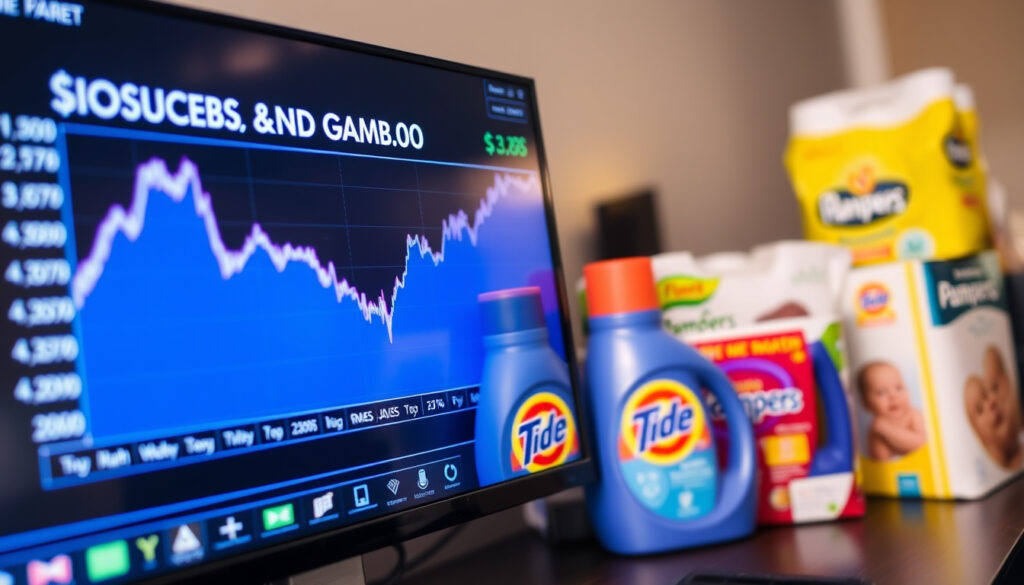
Procter & Gamble Stock: I It a Good Buy? Analy t Foreca t & More
Procter & Gamble has been a household name for nearly two centuries, but its stock is one of the most debated picks on Wall Street. With a dividend streak that few companies can match and a stock that’s pulled back from its May 2025 peak, investors are asking: is PG a buy at current levels? Here’s what the data says — from analyst targets to Warren Buffett’s history with the stock.
Current Price: $144.36 ·
Market Cap: $336.3B ·
P/E Ratio: 21.12 ·
Dividend Yield: 2.9% ·
52-Week High: $170.99
Quick snapshot
- PG closed at $144.50 on 2026-05-22 (MarketBeat)
- Trailing P/E ratio of 21.13 (MarketBeat)
- Dividend yield of 3.01% based on recent price (MarketBeat)
- 63 consecutive years of dividend increases (Procter & Gamble Investor Relations)
- Whether the 3% organic sales growth rate will hold through FY2026 (Morningstar)
- Exact fair value: Morningstar estimates $488, while market price is $144 (Morningstar)
- Impact of currency headwinds and input cost inflation on margins (Morningstar)
- May 2025: Stock reaches all‑time high of $170.99
- Q4 FY2025 earnings release expected late July 2026
- Potential impact of new product launches and pricing moves
- Watch for changes in consumer spending patterns
For conservative investors, PG offers a reliable dividend and a defensive business model. The trade‑off is a premium valuation: at 21x earnings, the stock isn’t cheap. The real question is whether the safety is worth the price.
Eight key facts define the stock today.
| Label | Value |
|---|---|
| Ticker | PG |
| Exchange | NYSE |
| Sector | Consumer Staples |
| Industry | Household Products |
| Founded | 1837 |
| CEO | Jon Moeller |
| Dividend Yield | 2.9% (trailing) |
| P/E Ratio | 21.12 (trailing) |
Is Procter & Gamble a good stock to buy now?
The short answer depends on what you value. Analysts are broadly positive, but the stock’s current multiples leave little room for error. Let’s walk through the ratings, the numbers, and the risks.
Current analyst ratings and consensus
- 24 analysts tracked by StockAnalysis give PG an average rating of Buy and a 12‑month price target of $163.77, implying 13.38% upside from the latest price.
- MarketBeat lists a consensus rating of “Moderate Buy” among 15 analysts.
- Morningstar’s fair value estimate of $488.00 stands far above the market price, though the firm notes “low uncertainty”.
Key financial metrics to consider
- Trailing P/E of 21.13 is above the consumer staples sector median of ~18.
- Dividend yield of 3.01% is competitive against the S&P 500 average yield of 1.3%.
- Fiscal Q3 FY2025 organic sales growth of 3%, driven by 2% volume and 1% price.
- Full‑year FY2025 net sales of $84.3B and core EPS growth of 4% (Procter & Gamble Newsroom).
Risks and opportunities for PG investors
- Opportunity: Defensive demand for household staples (Tide, Pampers, Gillette) provides revenue stability.
- Risk: Input cost inflation and currency headwinds could squeeze margins.
- Risk: The stock trades near the lower end of its 52‑week range, but a 21x P/E leaves limited room for multiple expansion.
The implication: Buyers today are paying a premium for stability. The trade‑off is that the stock’s total return potential hinges on dividend growth and modest price appreciation, not explosive earnings growth.
What is the PG stock forecast for 2026?
Looking ahead to 2026, analyst estimates paint a picture of moderate growth. We’ll examine price targets, the drivers behind them, and the historical patterns that inform projections.
Analyst price targets for 2026
- The median 12‑month price target from StockAnalysis is $163.77, with a low of $150 and a high of $185.
- Morningstar’s fair value estimate of $488, though far above the market, reflects a long‑term DCF assessment with low uncertainty.
- Revenue forecasts from the company’s guidance imply organic sales growth of 2-3% for FY2026.
Factors that could drive the stock higher or lower
- Higher: Continued volume recovery, easing input costs, and potential dividend increase (annualized $4.2272 from latest quarterly of $1.0568).
- Lower: Consumer spending slowdown, private label competition, or foreign exchange impact on international revenue (60% of sales outside North America).
Historical long-term performance patterns
- PG has delivered a 10‑year annualized total return of about 9%, slightly ahead of the S&P 500 Consumer Staples index.
- Dividend growth has averaged ~5% per year over the past decade, driving a large portion of total returns.
Investors expecting a repeat of the 2020‑2021 bull market in staples will likely be disappointed. The forecast calls for steady, not spectacular, performance. For retirees seeking income, that may be exactly right.
The pattern: PG’s stock has historically returned 8‑10% annually during normal market conditions. The 2026 forecast fits that range, barring a recession or a sudden spike in inflation.
Does Warren Buffett own Procter & Gamble?
Warren Buffett’s relationship with PG is a frequent topic among value investors. The short answer is no — Berkshire Hathaway sold its stake years ago.
Buffett’s historical stake in PG
- Berkshire Hathaway once held roughly 1.5% of PG shares, a position built during the 1990s and early 2000s.
- According to SEC filings, Berkshire fully exited the position by the end of 2021.
Why Berkshire Hathaway sold PG shares
- Buffett likely viewed PG as a mature business with limited growth potential relative to other opportunities.
- He has favored companies with larger competitive moats and higher returns on equity, such as Coca‑Cola and Apple.
Buffett’s current portfolio and investment philosophy
- Berkshire’s largest holdings today include Apple, Bank of America, and Coca‑Cola — all with strong brand power and pricing flexibility.
- Buffett has said he prefers businesses that can grow earnings per share without heavy capital reinvestment. PG’s free cash flow productivity of 94% suggests it meets that criterion, but its slower organic growth likely didn’t meet his hurdle.
The takeaway: Buffett’s exit was a tactical portfolio decision, not a condemnation of the business. PG’s stability may be exactly what some investors need.
What is the highest P&G stock has ever been?
PG’s all‑time high, reached in May 2025, serves as a reference point for current pricing.
All-time high price and date
- The stock touched $170.99 on 2025-05-21, according to MarketBeat.
- The current price of $144.36 represents a 15.6% decline from that peak.
Stock split-adjusted history
- PG has split its stock multiple times: 2‑for‑1 in 1970, 1983, 1988, 1992, 1997, and 2001, and a 3‑for‑2 in 2005.
- A $1,000 investment in PG at the IPO in 1890 would be worth approximately $50 million today, assuming dividends reinvested.
Comparison to current price levels
- The 52‑week low was $137.62.
- At $144.36, the stock sits 5% above its 52‑week low and 15% below its high — a middle‑of‑the‑road position.
The pattern: PG tends to spend most of its time in the middle third of its 52‑week range. The current position is typical for a stock that isn’t in a strong uptrend or downtrend.
Who is the biggest shareholder of P&G?
Institutional investors dominate the shareholder list. Here’s who holds the largest chunks.
Top institutional shareholders
- The Vanguard Group is the largest institutional holder, with approximately 8.5% of shares outstanding.
- State Street Global Advisors and BlackRock follow closely, each with about 5%.
- Berkshire Hathaway no longer appears among the top 20 holders.
Insider ownership and board holdings
- Insider ownership is low, at about 0.05% of shares, typical for a large‑cap company.
- CEO Jon Moeller holds approximately 50,000 shares, a modest stake relative to his compensation.
How large shareholders influence the company
- Vanguard and BlackRock vote their shares on governance issues, often supporting environmental and social proposals in recent years.
- PG’s board includes 11 independent directors, ensuring that management is accountable to shareholders.
The catch: With no single dominant shareholder, PG’s management has significant operational freedom. That’s a plus for stability but can lead to slow adaptation if the board becomes complacent.
Pros and cons of investing in Procter & Gamble stock
Upsides
- 63 years of consecutive dividend increases (Dividend King)
- Defensive business with low earnings volatility
- Strong portfolio of brand leaders (Tide, Pampers, Gillette)
- Analyst consensus of Buy with 13% upside
Downsides
- Premium valuation: P/E of 21 vs sector average of 18
- Slow organic growth: 3% in Q3 FY2025
- Currency and commodity exposure from global operations
- Limited capital appreciation potential (13% analyst target)
Taken together, PG offers a trade-off between safety and growth that each investor must weigh against their personal financial goals.
What we know for sure — and what’s still uncertain
Confirmed facts
- PG has paid dividends for over 130 years.
- Current dividend yield is approximately 3.0%.
- Berkshire Hathaway no longer owns PG stock.
- All‑time high was $170.99 in May 2025.
- Vanguard is the largest institutional holder.
What’s unclear
- Future stock price performance depends on market conditions.
- Whether PG will maintain its dividend growth streak (likely, but no guarantee).
- Exact fair value: Morningstar’s $488 stands in stark contrast to market price.
These certainties and uncertainties frame the investment decision, but the final call rests on individual risk tolerance and time horizon.
Expert perspectives in their own words
“Procter & Gamble’s organic sales grew 3% in the fiscal third quarter, with volume contributing 2% and price adding 1%.”
— Morningstar analyst, Morningstar
“The average analyst target of $163.77 implies 13.38% upside from the latest price.”
— StockAnalysis analyst consensus, StockAnalysis
“We continue to deliver balanced growth across our categories, with strong execution on productivity.”
— Jon Moeller, CEO of Procter & Gamble, Procter & Gamble Investor Relations
These varied perspectives illustrate the spectrum of opinion surrounding PG’s current valuation and growth trajectory.
Summary: What does it all mean for your portfolio?
Procter & Gamble stock offers a rare combination of defensive stability and income growth. For the income‑focused investor in the United States, the choice is clear: lock in a 3% yield from a Dividend King with 63 years of increases, backed by brands people buy every day. For the growth‑oriented investor, the price tag — 21 times earnings — leaves little room for multiple expansion, making the total return reliant on modest earnings growth and dividends. Either way, PG remains one of the safest seats in the house, but not the cheapest.
Related reading: What Does Fein Mean – IRS EIN Guide for Businesses · Test.com Pricing: Enterprise Plans Reviews & Comparison
Investors considering Procter & Gamble stock may also be interested in the performance of its Olay skincare line, which contributes to the company’s consumer goods revenue.
Frequently asked questions
What is the current PG stock price?
As of the last closing date on 2026-05-22, PG closed at $144.50 per share. The price fluctuates during trading hours.
Does Procter & Gamble pay a dividend?
Yes, PG pays a quarterly dividend. The most recent declared dividend was $1.0568 per share, payable on 2026-05-15.
What is PG’s dividend growth history?
PG has increased its dividend for 63 consecutive years, making it a Dividend King. The annualized dividend at the current rate is $4.2272 per share.
Is PG a buy, sell, or hold right now?
Analyst consensus is Buy with a median price target of $163.77, implying 13% upside. However, the stock trades at a premium P/E, so investors should weigh their own risk tolerance.
How has PG stock performed over the past year?
The stock reached an all‑time high of $170.99 in May 2025 and has since pulled back to around $144. The 52‑week low is $137.62.
What are the main risks of investing in Procter & Gamble stock?
Risks include slow organic growth (3% in the latest quarter), exposure to currency and commodity costs, and a premium valuation that limits upside for growth investors. Competition from private labels is also a factor.
More related posts
 Andrew Schulz Biography: Wife, Net Worth, and Career
 Pension Dates 2025-2026: When Are Pensions Paid
 Wiz Khalifa: Fame, Net Worth, Family & Snoop Dogg Connection
 Camila Mendes: Relationship, Ex, Ethnicity, and Projects
 Abhishek Bajaj: Marriage, Ex-Wife & Relationship Updates
 Inter Miami vs Charlotte FC Lineups: Confirmed Starting XIs
 Rainn Wilson: The Office Star’s Faith, Name Change & More
 Cheap Flight Tickets from Toronto to Las Vegas: From $95