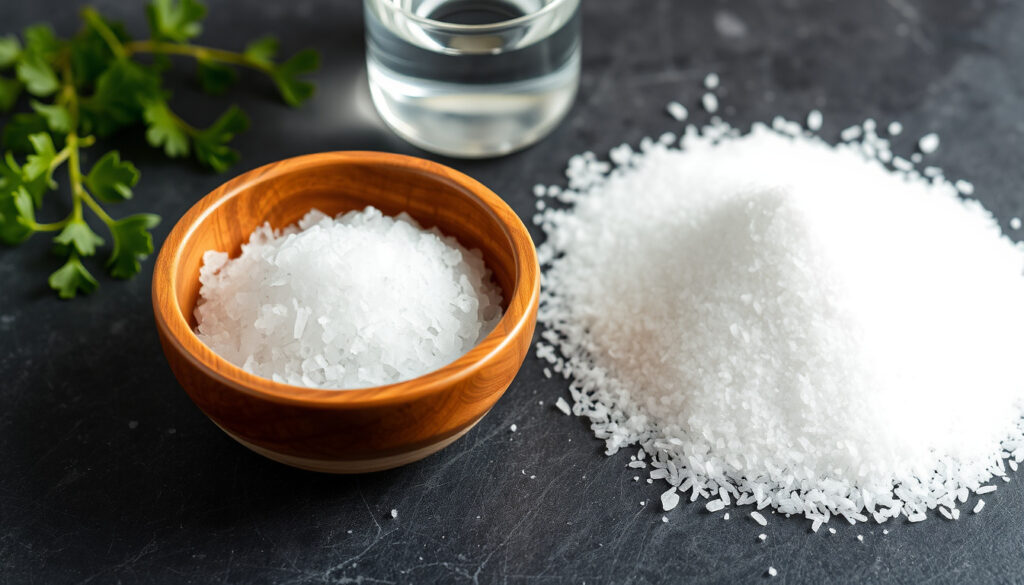
Sea Salt: Benefits, Differences, and Health Risks
Sea salt is not a single thing. From mass-produced evaporated salt to hand-harvested Irish artisanal flakes, the differences in mineral content and processing matter—but not in the way you might think. This guide compares sea salt, table salt, and Himalayan salt, with a focus on sodium content, trace minerals, and the growing market for Irish artisanal sea salts.
Sodium content per teaspoon: 2,300 mg (same as table salt) | Trace minerals in sea salt: Up to 2% (magnesium, calcium, potassium) | Daily sodium limit (US guidelines): < 2,300 mg per day | Global salt production from seawater: Approximately 30% of total salt | Number of artisanal sea salt producers in Ireland: At least 5 (Achill, West of Dingle, etc.)
What Is Sea Salt?
- Harvested from evaporated seawater
- Minimally processed
- Contains trace minerals
Sea Salt vs Table Salt
- Table salt has additives
- Sea salt coarser texture
- Both same sodium content
Source: Tua Saúde
Health Considerations
- Sodium still a concern
- May contain microplastics
- No proven health advantage
Source: Medical News Today
| Attribute | Sea Salt | Table Salt | Himalayan Salt |
|---|---|---|---|
| Sodium per teaspoon | 2,120–2,300 mg | 2,300–2,330 mg | 2,200 mg |
| Trace minerals | Up to 2% | Almost none | Up to 2% (84 trace minerals claimed) |
| Processing | Evaporation, minimal | Heavily refined, anti-caking agents | Mined, lightly ground |
| Iodine | Usually absent | Often added | Usually absent |
| Common source | Seawater | Underground deposits | Khewra mine, Pakistan |
The table below shows how each salt type stacks up in the key metrics that matter.
Upsides of Sea Salt
- Less processed, retains appealing texture
- Contains trace minerals (magnesium, calcium, potassium)
- Artisanal varieties offer unique flavors and local economic support
Downsides of Sea Salt
- Same sodium content as table salt — excess still raises blood pressure
- May contain microplastics and heavy metals from ocean pollution
- Lack of iodine can be a concern for thyroid health
Source: Medical News Today
What are the benefits of sea salt?
Sea salt is often praised for being less processed than table salt. Because it is produced by evaporating seawater, it retains trace minerals like magnesium, calcium, and potassium. However, the mineral content is too low to provide significant health benefits. Both sea salt and table salt contain about the same amount of sodium by weight.
Is sea salt good for you?
In moderation, yes — but no more so than any other salt. The World Health Organization recommends adults consume less than 2,000 mg of sodium per day. Sea salt contains roughly 2,300 mg of sodium per teaspoon, so even one teaspoon nearly meets the daily limit.
Does sea salt contain more minerals than table salt?
Yes, but the difference is negligible. The Administration for Community Living reports that fine sea salt contains 2,120 mg sodium per teaspoon, while table salt contains 2,330 mg. The trace minerals in sea salt account for the slight difference, but they do not confer measurable health benefits, as noted by McGill University’s Office for Science and Society.
The implication: Sea salt’s mineral content is a marketing advantage, not a health one. The real benefit is texture and flavor, not nutrition.
What is the difference between sea salt and table salt?
Table salt is mined from underground deposits and heavily processed to remove minerals. Anti-caking agents and iodine are often added. Sea salt is produced by evaporating seawater and retains some trace minerals. The texture and taste differ, but the sodium content is nearly identical.
How are sea salt and table salt produced?
Sea salt is harvested through solar evaporation of seawater. Table salt comes from underground salt mines, then refined to remove impurities and minerals. The Medical News Today notes that both are about 98% sodium chloride.
What is the difference in taste and texture?
Sea salt often has a coarser, flakier texture and a more complex flavor due to trace minerals. Table salt is fine-grained and dissolves quickly. The WebMD states that many chefs prefer sea salt for finishing dishes.
“The sodium content differences among common salts are irrelevant in the context of the overall diet.”
— McGill University Office for Science and Society
Is it good to eat sea salt every day?
No, not in excess. The U.S. Food and Drug Administration sets the Daily Value for sodium at less than 2,300 mg per day, and Americans average about 3,400 mg. Sea salt contributes the same sodium as table salt, so daily use without moderation can increase hypertension risk.
How much sea salt is safe per day?
The World Health Organization recommends less than 5 g of salt (about 1 teaspoon) per day. That includes all salt sources, not just added salt.
Can sea salt cause high blood pressure?
Yes. The American Heart Association warns that high sodium intake is a major contributor to hypertension. Sea salt is no exception.
Warning: Switching to sea salt does not protect against high blood pressure. The sodium content is nearly identical.
What is the disadvantage of sea salt?
Beyond the sodium issue, sea salt can contain trace amounts of heavy metals and microplastics from ocean pollution. Additionally, it usually lacks iodine, which is essential for thyroid function.
Does sea salt contain heavy metals?
Some studies have found lead, mercury, and other heavy metals in sea salt, though levels are typically low. The Healthline notes that the risk is minimal for most people, but it’s a concern for those consuming large amounts.
Is sea salt less pure than table salt?
Yes, because it retains impurities from seawater, including microplastics. A 2024 article from ScienceDirect found microplastics in many sea salt brands. Table salt, being refined, is generally free of these contaminants.
“The lack of iodine in sea salt may be a disadvantage for thyroid health, especially in areas where iodine-fortified foods are not common.”
What is the healthiest salt to eat?
No salt is significantly healthier than another. All are high in sodium. The Healthline concludes that the healthiest choice is to limit total sodium intake, regardless of salt type.
What is the unhealthiest salt?
Any salt consumed in excess is unhealthy. Salt with added anti-caking agents or refined sugars might be less desirable, but the biggest risk is sodium load.
How does Himalayan salt compare to sea salt?
Himalayan salt is mined from ancient salt beds and contains up to 84 trace minerals. However, the WebMD states that it contains roughly the same amount of sodium per teaspoon as ordinary table salt and fine sea salt. The mineral content difference is negligible for health.
The pattern: Marketing claims of superior health benefits for Himalayan salt are not supported by scientific evidence. Both sea salt and Himalayan salt are about 98% sodium chloride.
Is Himalayan salt really better than sea salt?
No. The Medical News Today explains that pink Himalayan salt is chemically similar to table salt. The trace minerals in Himalayan salt are present in such small amounts that they do not provide a health advantage over sea salt.
What minerals does Himalayan salt contain?
Himalayan salt contains minerals like calcium, potassium, magnesium, and iron, giving it its pink color. The Tua Saúde article notes that sea salt also contains these minerals, though in slightly different proportions.
Is Himalayan salt less processed than sea salt?
Both are minimally processed. Himalayan salt is hand-mined and usually not refined, while sea salt is evaporated. The Administration for Community Living shows that fine Himalayan pink salt has 2,200 mg sodium per teaspoon, close to sea salt’s 2,120 mg.
“The FDA equates 2,300 mg of sodium to about 1 teaspoon of table salt.”
factually.co, greenapplehealthcare.ca, nutriscan.app, thecoconutmama.com, moonjuice.com
Frequently Asked Questions
What is another name for sea salt?
Sea salt is also known as bay salt, solar salt, or fleur de sel.
How is sea salt made?
It is made by evaporating seawater, usually in shallow ponds, leaving behind salt crystals.
Does sea salt contain iodine?
Usually not, unless iodine is added. Table salt is often fortified with iodine to prevent deficiency.
Can sea salt go bad?
Sea salt does not expire because it is a mineral. However, if it contains added ingredients like herbs, those may degrade.
Is sea salt better for high blood pressure than table salt?
No, because both contain the same amount of sodium. Reducing overall sodium intake is more important.
What are the different types of sea salt?
Common types include fleur de sel, sel gris, Maldon salt, and Celtic sea salt. Each varies in texture and mineral content.
How should I store sea salt?
Store in an airtight container in a cool, dry place to prevent clumping.
Salt Bae Decline: Closures, Net Worth, World Cup Controversy
More related posts
 Tren Twins: Age, Height, Real Names & Net Worth (2024 Guide)
 Adam Silver: NBA Commissioner Career, Salary, Health, Stances
 Atlanta Falcons vs Tampa Bay Buccaneers Match Player Stats
 Rishi Kapoor: Cause of Death, Last Wish, and Controversial Views
 Tim Tebow: NFL Career, Dyslexia, Philanthropy, and Life Today
 Michelle Dockery: Baby, Fiancé Death, Ethnicity, and Downton Abbey