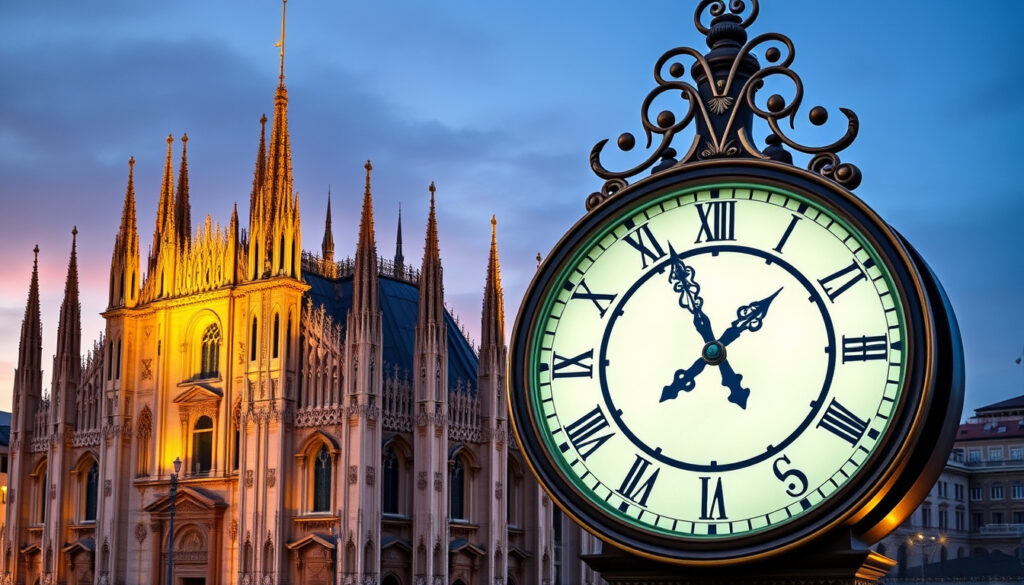
What Time Is It in Milan – CET/CEST Zone and DST Guide
Milan, Italy, operates on Central European Time, switching between standard time and summer time each year. The city follows the same time zone rules as the rest of continental Europe, making it straightforward for travelers and businesses to coordinate schedules. Understanding Milan’s time zone becomes essential when planning video calls across the Atlantic or timing arrivals for flights.
The northern Italian metropolis aligns with the IANA time zone database under the Europe/Rome identifier. This system automatically handles transitions twice yearly, ensuring clocks move forward in spring and back in autumn. For anyone asking what time it is in Milan right now, the answer depends on whether daylight saving time is currently active.
Italy’s national tourism portal confirms the dual-zone approach, with UTC+1 during winter months and UTC+2 during summer. The country has maintained this pattern since adopting harmonized European Union time rules in 1996, creating consistent scheduling across member states.
What Time Zone is Milan In?
Milan sits within the Central European Time zone, but this designation changes seasonally. During the colder months, the city operates on CET (UTC+1). When warmer weather arrives, Milan’s clocks shift forward to CEST (UTC+2). This twice-yearly adjustment follows a predictable schedule that affects everything from business hours to flight bookings.
- Milan follows EU-harmonized daylight saving time rules established in 1996
- The city transitions on the last Sunday of March and October each year
- Clocks change at 02:00 local time, shifting forward or backward by one hour
- During summer, Milan sits 6 hours ahead of New York and 1 hour ahead of London
- The IANA database identifies this zone as Europe/Rome
- No exceptions or local variations exist from the standard EU schedule
| Attribute | Value |
|---|---|
| Local Time Format | 24-hour |
| UTC Offset (Winter) | UTC+1 (CET) |
| UTC Offset (Summer) | UTC+2 (CEST) |
| DST Start | Last Sunday of March |
| DST End | Last Sunday of October |
| IANA Identifier | Europe/Rome |
Current Time in Milan Right Now
On April 16, 2026, Milan is experiencing its mid-spring period under Central European Summer Time. This means the city currently operates on CEST (UTC+2), having switched from standard time on the last Sunday of March. The transition occurred at 02:00, when clocks moved forward one hour to 03:00.
Those checking the current time in Milan should note that the shift to summer time adds an hour of evening daylight but creates a one-hour difference compared to winter scheduling. Business contacts in Milan will be available during different windows depending on whether you call from a location that has also transitioned to summer time.
Checking Milan Time on Your Devices
Most smartphones and computers automatically update to reflect local time in Milan once regional settings are configured correctly. The Europe/Rome time zone selection ensures your device follows the same CET/CEST pattern as the city itself. Manual adjustments become unnecessary when proper zone settings are applied.
Time accuracy depends on network synchronization. When traveling across time zones, enabling automatic updates on your device ensures continued accuracy without manual intervention.
Time Difference: Milan vs Major Cities
Understanding how Milan’s time compares to other global cities helps when scheduling international calls or planning travel. The differences remain relatively stable throughout the year, with minor variations during the week when daylight saving transitions occur at different dates.
| City | Winter (CET) | Summer (CEST) | Notes |
|---|---|---|---|
| New York (EST/EDT) | +6 hours | +6 hours | Differences may shift briefly during transition weeks |
| London (GMT/BST) | +1 hour | +1 hour | Consistent year-round difference |
| Los Angeles (PST/PDT) | +9 hours | +9 hours | Six-hour swing during US DST transitions |
| Tokyo (JST) | -8 hours | -8 hours | Japan does not observe DST |
When it is noon in Milan during winter, New York sits at 06:00 and London at 11:00. The same noon timing in summer maintains these consistent offsets because both regions shift their clocks simultaneously. This parallel movement keeps business hours relatively aligned throughout the year.
Scheduling Calls with New York
Calling New York from Milan requires accounting for the six-hour gap. Late morning calls between 10:00 and 12:00 Milan time reach New York contacts in their early morning hours. Afternoon slots around 14:00 to 16:00 Milan time correspond to reasonable morning hours in New York. Those wondering about 70 Fahrenheit to Celsius conversions might also benefit from understanding time zones when coordinating weather-dependent activities.
During the weeks surrounding DST transitions, brief discrepancies may occur if the EU and US shift on different dates. Checking current offsets before important calls prevents confusion during these periods.
Milan Daylight Saving Time Rules
Milan observes daylight saving time following the EU Summer Time Directive, which standardizes clock changes across member states. The system divides the year into two distinct periods: standard time from late October until late March, and summer time from late March until late October.
When Clocks Change
The spring transition occurs on the last Sunday of March. At 02:00 local time, clocks advance to 03:00, marking the beginning of Central European Summer Time. For example, on Sunday, March 30, 2025, residents set their clocks forward at 2:00 am. The autumn reversal happens on the last Sunday of October, when clocks retreat from 03:00 back to 02:00.
This twice-yearly adjustment has roots in energy conservation efforts, though debates about its continued necessity have circulated through EU institutions. The European Commission has reviewed the practice, though current rules remain in effect. The system creates longer summer evenings but requires individual adjustment twice annually.
Is Milan on CEST Now?
Determining whether Milan currently uses CEST involves checking the date against the standard transition dates. From late March through late October, summer time applies. Outside that window, standard CET takes effect. The switch happens uniformly across Italy and other EU nations sharing this time zone.
Visitors unfamiliar with European DST may miscalculate meeting times during transition weeks. Recording the specific date of your engagement rather than relying on seasonal assumptions prevents scheduling errors.
Annual Time Changes: A Visual Timeline
Understanding the rhythm of Milan’s clock changes helps anticipate shifts throughout the year. The following sequence marks the critical transition points that affect daily life in the city.
- Last Sunday of March (02:00): Clocks advance to CEST (UTC+2), beginning summer time observation
- Late October (03:00): Clocks retreat to CET (UTC+1), returning to standard time
- 1996 EU Harmonization: Italy adopted current synchronized DST rules, aligning with neighboring countries
- Historical Pre-1996: Italy previously observed various local time arrangements before standardization
Those comparing 80 F to C temperature conversions during planning may find the seasonal transitions relevant, as summer months bring different weather considerations alongside the time shift.
Understanding What We Know and What Remains Uncertain
Milan’s time zone information ranks among the most precisely documented systems globally. Official sources confirm the exact mechanisms and dates governing clock changes. Network time protocols ensure digital devices maintain accuracy down to fractions of a second.
| Established Information | Information That Remains Uncertain |
|---|---|
| DST follows EU rules, changing on last Sundays of March and October | Future changes to EU DST policy remain under discussion |
| UTC+1 applies during winter; UTC+2 during summer | Individual device synchronization depends on user settings |
| Milan uses Europe/Rome IANA identifier | Exact moment of transition for specific local ceremonies |
| Six-hour difference from New York EST/EDT | Minor variations during transition week coordination |
While the fundamental time zone mechanics are fixed by law and international agreement, broader policy discussions continue regarding DST’s utility. The European Commission has gathered feedback on potentially ending the practice, though no changes have been implemented as of this writing.
Historical Context of Milan’s Time Zone
Italy’s relationship with standardized time has evolved significantly over the past century. Before 1996, European nations operated under varying local interpretations of time, creating complications for cross-border commerce and communication. The EU Summer Time Directive brought consistency across member states, with Italy adopting the harmonized approach that remains in place today.
The rationale behind daylight saving time centers on energy conservation and maximizing natural daylight during extended summer evenings. By shifting clock schedules forward, evening activities consume less artificial lighting during the months when daylight extends later into the day. Critics question whether the benefits justify the disruption of twice-yearly transitions, but current regulations show no signs of imminent change.
Italy’s adoption of these rules aligned it with neighboring France, Germany, and other continental nations sharing the CET/CEST system. Travelers moving between these countries experience seamless time coordination without additional adjustments. The official Italy tourism portal confirms these arrangements for visitors planning their itineraries.
Sources and Official References
Multiple authoritative sources document Milan’s time zone configuration. The IANA Time Zone Database provides the foundational data used by operating systems worldwide. Wikipedia’s comprehensive entry on Time in Italy traces the historical development of these arrangements. Official EU documentation outlines the harmonized approach governing all member states.
Italy’s national tourism site confirms CET (UTC+1) in winter and CEST (UTC+2) in summer per EU rules. No recent changes noted; rules remain stable under EU directive for energy savings and scheduling coordination.
— italia.it Official Tourism Portal
Italy has observed this CET/CEST system since adopting EU harmonized DST rules in 1996, with start/end on last Sundays of March/October at 02:00 CET. Prior variations existed, but post-1996 aligns with the EU Summer Time Directive for continental coordination.
— Wikipedia: Time in Italy
Summary
Milan operates on Central European Time, switching between CET (UTC+1) during winter and CEST (UTC+2) during summer. The transition follows EU rules, with clocks advancing on the last Sunday of March and retreating on the last Sunday of October. This schedule keeps Milan six hours ahead of New York and one hour ahead of London throughout the year. The system has remained stable since Italy adopted harmonized EU time regulations in 1996.
Frequently Asked Questions
What country is Milan in?
Milan is located in northern Italy, within the Lombardy region. It stands as the country’s second-largest city by population after Rome.
How do I set Milan time on my phone?
Navigate to your device’s date and time settings, enable automatic time updates, and select Europe/Rome as the time zone. This automatically applies both CET and CEST adjustments.
Does Milan observe daylight saving time?
Yes. Milan follows the EU-harmonized DST schedule, advancing clocks one hour on the last Sunday of March and returning them on the last Sunday of October.
What is the UTC offset for Milan?
Milan uses UTC+1 (CET) during standard time and UTC+2 (CEST) during daylight saving time. The current offset depends on whether summer time is active.
How many hours ahead of New York is Milan?
Milan typically runs six hours ahead of New York, regardless of the season. Both regions shift their clocks simultaneously, maintaining this consistent gap.
When does DST start in Milan?
Daylight saving time begins on the last Sunday of March at 02:00 local time, when clocks move forward to 03:00 CEST. This date varies slightly each year.
More related posts
 Johnny Lewis Death: What Happened to the SOA Actor
 Pat Benatar: Illness, Husband, Famous Songs, and Biography
 Verne Troyer Death, Career, and Net Worth
 Cole Escola: Pronouns, One Piece Role, and Tony Awards
 Hailey Baptiste: Height, Ranking, Nationality & Career Goals
 Jo Koy: Relationship, Ex-Wife, Net Worth, and Career (2025)
 Houses for Sale Kamloops – Prices Listings Neighborhoods Guide
 Scooter Braun: Taylor Swift Feud, Career & Retirement