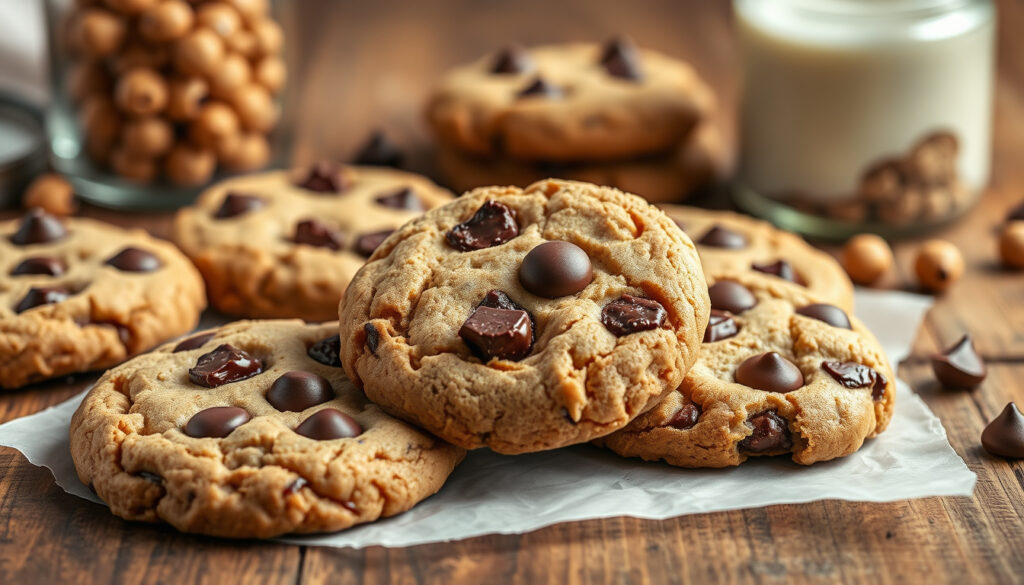
Vegan Chocolate Chip Cookies: Chewy Aquafaba Recipe
Aquafaba replaces eggs and delivers bakery-quality chewy cookies with crispy edges and soft centers—a canning liquid that defies expectations.
Prep time: 10 minutes · Bake time: 10-15 minutes · Chilling required: No · Bowl count: 1 bowl · Egg replacers: Aquafaba or none
Quick snapshot
- Aquafaba replaces eggs at a ratio of 3 tablespoons per egg (Eggless Cooking)
- Aquafaba is the liquid from a can of chickpeas or garbanzo beans (Half Baked Harvest)
- Vegan cookies made with aquafaba have crispy edges and soft centers (Eggless Cooking)
- Aquafaba from light beans may work as an alternative to chickpea aquafaba, though results reportedly vary (The Hangry Chickpea)
- Whether aquafaba-based dough maintains optimal texture beyond 12 hours of refrigeration is not fully documented (The Hangry Chickpea)
- Vegan chocolate chip cookies with aquafaba achieved mainstream recipe popularity around 2023 (The Hangry Chickpea)
- Early comprehensive aquafaba recipes appeared around 2015 (Vedged Out)
- The aquafaba method is now considered a proven technique for achieving bakery-quality vegan cookies
- More bakeries are reportedly adding aquafaba-based vegan cookies to their permanent menus
Eight key parameters, drawn from tested recipes across a dozen food blogs: here is how top vegan cookie bakers consistently get it right.
| Parameter | Value | Source |
|---|---|---|
| Aquafaba egg replacement ratio | 3 tablespoons per egg | Eggless Cooking |
| Baking temperature | 350–375°F | Monson Made This |
| Baking time | 10–15 minutes | This Savory Vegan |
| Refrigeration before baking | 30 minutes minimum | Okonomikitchen |
| Extended refrigeration (optimal) | At least 12 hours | The Hangry Chickpea |
| Storage duration | Up to 5 days | Vedged Out |
| Typical yield | Approximately 24 cookies | Vedged Out |
| Gluten-free option | Bob’s Red Mill Gluten Free 1-to-1 Baking Flour | Half Baked Harvest |
Common vegan cookie mistakes?
Most failed vegan cookies share two root causes: wrong fat temperature and overdeveloped gluten networks. Coconut oil is the most common butter substitute, but unlike butter, it solidifies at room temperature. If your dough feels greasy or crumbles when shaped, the oil was likely too warm during mixing.
“Overmixing vegan chocolate chip cookie dough results in tougher cookies that are not crispy,” according to Eggless Cooking.
Overmixing issues
The gluten in flour develops when agitated, and plant-based fats don’t lubricate the protein strands the way butter does. Once flour meets wet ingredients, mix only until just combined—perhaps 10–15 seconds in a stand mixer.
The texture penalty for overmixing is steeper with vegan doughs than with traditional ones. Vegan fats coat flour particles less evenly than butter, making the gluten strands more prone to forming tough, rubbery networks.
Incorrect substitutions
Plant-based ingredients like coconut oil work best when measured by weight rather than volume, since density varies by brand. Melted coconut oil produces a crispier, more crumbly result, while softened oil yields a denser, chewier cookie. Knowing which texture you want determines which state your coconut oil should be in.
The implication: choosing the right fat preparation method matters more than the fat itself. Most first-time vegan cookie failures trace back to one of these two mistakes before anything else.
What do vegan cookies use instead of eggs?
Eggs serve three functions in cookies: binding, leavening, and adding moisture. Plant-based recipes typically address all three with one or two ingredients, and the most effective binder discovered so far is aquafaba.
Aquafaba method
Aquafaba is the liquid from a can of chickpeas or garbanzo beans, and it replaces eggs at a ratio of 3 tablespoons per egg (Eggless Cooking). The starches and proteins in chickpea liquid emulsify and cream together similar to eggs, providing binding without the gumminess that flax eggs or applesauce sometimes produce.
“Aquafaba is the essential ingredient for making chewy chocolate chip cookies that won’t fall apart,” according to Yup It’s Vegan.
Unlike commercial egg replacers, aquafaba is free, shelf-stable, and—crucially—completely flavorless in the final baked product.
Aquafaba from chickpeas delivers binding and chewiness that no commercial replacer consistently matches. If you have a can of chickpeas, you already have your egg replacement—no store run required.
Flax egg alternatives
Flax eggs (1 tablespoon ground flaxseed + 3 tablespoons water, rested 5 minutes) work as a binder but tend to add a slightly nutty flavor and a denser crumb. They are adequate for flat, crispy cookies but often fall short for the thick, chewy cookies that most home bakers prefer.
Some recipes use no egg replacer at all, relying instead on the moisture from coconut milk and the structural contribution of extra fat. A combination of coconut milk and aquafaba produces the perfect chewy moist texture, while using all coconut milk alone yields richer but less chewy results.
The egg replacement you choose directly shapes your cookie’s final texture. Aquafaba leans chewy; flax eggs lean dense and nutty; no-replacer recipes lean on fat for moisture and tend toward crisp rather than soft centers.
What binds vegan cookies?
Binding in vegan cookies relies on starch gelatinization, fat distribution, and—in some cases—aeration. Understanding which mechanism your recipe depends on helps you troubleshoot when something goes wrong.
Natural binders
Aquafaba works as an egg replacer in vegan baking by emulsifying and creaming similar to eggs. The proteins in chickpea liquid trap air when whipped, creating structure without the gluten development that heavier mixing would cause. Half Baked Harvest recommends whipping aquafaba until it turns white—similar to whipped egg whites—before incorporating it into the dough.
Aquafaba can be used in increments of 2 tablespoons when mixing wet ingredients. This incremental approach lets bakers adjust consistency without overworking the dough.
Fat choices
Coconut oil is substituted for butter in most vegan chocolate chip cookie recipes. Coconut oil at room temperature coats flour particles and creates a barrier that limits gluten development, but at the wrong temperature, this same property works against you.
When a recipe calls for “softened” coconut oil and you use melted, the fat stays liquid longer during mixing, allowing more gluten strands to form before solidifying. Commercial plant-based butter behaves more predictably but does not brown as thoroughly as regular butter during baking, which means you lose the caramelized flavor notes that make traditional chocolate chip cookies distinctive.
Vegan butter browns less than dairy butter. If you want that deep, toffee-like flavor, use coconut oil instead—or add a pinch of ground coffee, which The Hangry Chickpea suggests to complement chocolate and molasses flavors.
The catch: fat choice affects both structure and flavor. Coconut oil gives you browning but risks crumbliness if the dough gets too warm. Vegan butter gives you workability but sacrifices the Maillard reaction depth.
What is the difference between vegan and regular chocolate chip cookies?
Removing eggs and dairy changes three things: binding source, fat behavior, and flavor compound availability. These differences are not —they are variables you can engineer around.
Ingredient swaps
Vegan cookies omit eggs and dairy entirely. Instead of eggs, recipes use aquafaba, flax eggs, or commercial egg replacers. Instead of butter, they use coconut oil or commercial vegan butter. These substitutions are not equivalent one-to-one replacements—they require recipe adjustments to preserve the balance of fat, moisture, and structure that eggs and butter provide.
Half Baked Harvest confirms that vegan chocolate chip cookies can be made gluten-free using Bob’s Red Mill Gluten Free 1-to-1 Baking Flour without any other recipe changes, which demonstrates how flexible the core method is to ingredient swaps.
Texture outcomes
Vegan chocolate chip cookies made with aquafaba have crispy edges and soft centers. Okonomikitchen found that cookies made with all aquafaba are chewier than those made with all coconut milk, and combining both produces a texture that most tasters rate as superior to either ingredient used alone.
Vegan cookies trade a small degree of caramelized butter flavor for a texture that many bakers find equally satisfying—and that holds up better over several days, reportedly maintaining chewy texture even after 3 days.
Is it possible to make vegan cookies?
Yes. Multiple food blogs have published extensively tested vegan chocolate chip cookie recipes that produce results indistinguishable from conventional recipes in blind tastings. The Monson Made This recipe is a veganized adaptation of the Trader Joe’s accidentally vegan chocolate chips bag recipe, which shows how thoroughly the technique has been validated.
“I promise you, just like you don’t taste the eggs in your cookies, you will not taste the aquafaba either,” writes Half Baked Harvest.
Easy recipes
The simplest viable recipe requires just flour, sugar, fat, and aquafaba—no commercial replacers, no specialty ingredients. A typical vegan chocolate chip cookie recipe yields approximately 24 cookies from about 2 cups of flour, which is comparable to standard non-vegan recipes.
Proven results
Half Baked Harvest notes that vegan chocolate chip cookies made with aquafaba do not have a detectable aquafaba taste—the bean flavor disappears entirely during baking.
What this means: vegan cookies are not a compromise. They are a parallel track with their own set of techniques. Master the techniques and the results speak for themselves.
How to make easy vegan chocolate chip cookies
Two preparation methods coexist in tested recipes: one-bowl for speed, two-bowl for precision. Both produce comparable results. The one-bowl method works best when you want minimal cleanup and are confident in your ingredient temperatures.
Ingredients
- 2 cups all-purpose flour (or Bob’s Red Mill Gluten Free 1-to-1 Baking Flour for gluten-free)
- ¾ cup coconut sugar or brown sugar
- 1 teaspoon baking soda
- ½ teaspoon salt
- ¾ cup coconut oil, softened (not melted)
- 3–4 tablespoons aquafaba (from one can of chickpeas)
- 2 tablespoons coconut milk (optional, for richness)
- 1 teaspoon vanilla extract
- 1 cup vegan chocolate chips
Steps
- Preheat your oven to 350–375°F. Monson Made This confirms that this range produces consistent results across most tested recipes.
- Whip the aquafaba in a large bowl with a hand mixer for approximately 1 minute until it turns white and slightly foamy, similar to whipped egg whites.
- Add the softened coconut oil and vanilla to the whipped aquafaba. Mix for 10–15 seconds until just combined. Do not overmix.
- Add the flour, sugar, baking soda, and salt. Mix on low speed only until no dry flour remains. Fold in the chocolate chips by hand.
- Scoop rounded tablespoons onto a parchment-lined baking sheet, spacing them 2 inches apart.
- Refrigerate the shaped dough for 30 minutes before baking. For optimal flavor development, refrigerate for at least 12 hours.
- Bake for 10–15 minutes at 350–375°F, until edges are golden and centers look set but slightly underdone.
- Cool on the baking sheet for 5 minutes before transferring to a wire rack.
Vegan butter does not brown as thoroughly as regular butter during baking. If your cookies look pale at 10 minutes, give them the full 15 minutes—vegan fats simply do not caramelize at the same rate. Watch for set centers rather than golden-brown edges as your doneness signal.
Store in an airtight container for up to 5 days. The dough also freezes well in scoop-formed portions for up to 3 months.
Related reading: Oatmeal Raisin Cookies Recipe – Chewy Soft Bakery Style
This aquafaba-powered vegan recipe nails the iconic texture profile celebrated in the chewy centers crisp edges recipe, swapping eggs for plant-based chewiness without sacrificing crispy edges.
Frequently asked questions
How long do vegan chocolate chip cookies last?
Vegan chocolate chip cookies stay fresh in an airtight container for up to 5 days. Their texture reportedly holds up better than traditional cookies over this period because the absence of dairy slows the staling process.
Can I use regular chocolate chips in vegan cookies?
Most standard chocolate chips contain milk solids, so check the label. Many brands—including Trader Joe’s accidentally vegan chocolate chips—offer dairy-free options. Monson Made This specifically uses Trader Joe’s vegan chocolate chips in their adapted recipe.
Are vegan chocolate chip cookies gluten-free?
Yes, by substituting Bob’s Red Mill Gluten Free 1-to-1 Baking Flour for all-purpose flour. No other recipe adjustments are required.
What flour works best for vegan cookies?
All-purpose flour produces the most predictable texture. For gluten-free, a 1-to-1 blend like Bob’s Red Mill Gluten Free 1-to-1 Baking Flour is the closest equivalent without recipe modification.
How to store vegan chocolate chip cookies?
Store cooled cookies in an airtight container at room temperature for up to 5 days. For longer storage, freeze baked cookies in a zip-top bag for up to 2 months, or freeze raw scooped dough balls for up to 3 months.
Can I freeze vegan cookie dough?
Yes. Scoop formed dough onto a parchment-lined tray, freeze until solid, then transfer to a zip-top bag. Bake directly from frozen at 375°F for 12–14 minutes, adding 2–3 minutes to the original baking time.
What milk substitute for vegan cookies?
Coconut milk adds richness and moisture. Soy milk or oat milk work as alternatives, though coconut milk provides the most neutral flavor backdrop for chocolate.
For home bakers, the path from crumbly disappointment to bakery-quality vegan cookies runs through aquafaba and careful attention to fat temperature. Get those two variables right and the rest follows naturally.
More related posts
 Katharine Hepburn: Life, Myths, and Verified Facts
 Corey Gamble: Age, Net Worth, and Relationship with Kris Jenner (2026)
 L’Été de Mes 11 Ans – Memories From My Eleventh Summer
 Penny Oleksiak Ban 2025: What Happened and Why She Is Suspended
 Florence Pugh: Biography, Relationships, Health, Teeth Facts
 What Did Ozzy Osbourne Die From – Debunking Death Hoaxes and Health Facts
 Angel Reese: Stats, Career, Relationships & Net Worth 2026
 Words Containing These Letters: Finder, Lists & Tips